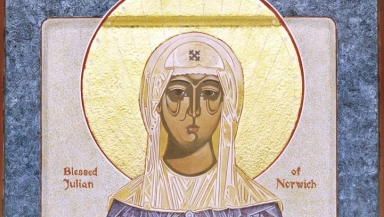
8 May is the traditional day to remember Mother Julian of Norwich. She is important because her book remains a classic of Christian spirituality and is the first book in English known to have been written by a woman. This is her story …
Anchorites
One class of hermit was the reclusive anchorites, who took a vow of poverty, a vow of chastity, and a vow to be anchored to one place. The term ‘anchorite’ comes from the Greek word άναχωρητής (anachoretes). These were men or women who lived in a cell or room, also called anchorholds, attached to a church to devote their lives to prayer. Being anchored to one spot, they were called anchorites, and female anchorites, who were more common, were known as anchoresses. Many churches had them, and they would have been connected to a priory, but instead of living in community, they lived in isolation except for visits.
An anchorite’s cell
A church might have had a cell occupied by successive anchorites or anchoresses. These varied in size but usually amounted to one or two rooms built against the church wall, with a window to the outside to allow food to be passed in and waste to be removed via a chamber pot. There would also be a window into the church, through which the anchorite received communion.
Once an anchorite was in the cell, the door connecting it to the church building would have been sealed or locked, but the windows allowed them to talk to visitors and receive food, clothing, and other items. People would bring them food, or someone from the local abbey might be assigned to look after them.
Conditions did vary. Some anchorites were walled in, but others could wander around the church, and some had their own walled gardens. Sometimes they could leave temporarily to go on pilgrimage. Anchorites were seen as holy and were often consulted by others; some became famous and received visitors from afar.
Mother Julian
One such anchoress was known as Mother Julian and lived in Norwich. She was born about 1342 in Norwich. She was six years old when the Black Death came to the city and devastated the population, and she was one of its survivors. Some wonder if the experience of losing her family to the plague led her to a life as an anchoress. Others suggest she may already have been an anchoress before the plague and that her isolation saved her from infection.
Norwich
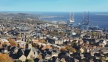
The English city of Norwich lies in Norfolk in East Anglia, in the south of England, where it juts into the North Sea. In medieval times, Norwich was the second-largest city in England after London, at a time when the population of the whole country was just a few million. It was a wealthy city through trade with the Low Countries. In medieval times, the city had a cathedral, five monasteries, a convent, and many parish churches. There were many priests, monks, nuns, and anchorites, creating a vibrant religious life.
The name Julian
To many, it may seem odd that Mother Julian bears what is now considered a male name. In medieval England, the name ‘Julian’ was used for both genders, although today we would use Julian as a male name and Juliana as the female variant. She is also called Dame Julian, Mother Julian, or Juliana of Norwich in different books. In fact, her real name is not known.
Julian might have been her real name or a new religious name taken on entering the convent. Many experts think that the name Julian may have been taken from St Julian’s Church in Norwich, where she was anchored, and that she became known as Julian by reference to her location. In turn, St Julian’s Church is not named after her but was dedicated to an earlier St Julian, though it is not certain which one: St Julian of Le Mans, St Julian the Hospitaller, or St Juliana of Nicomedia.
St Julian’s Church, Norwich
St Julian’s Church is in the south of Norwich and was built on the site of an earlier Anglo-Saxon church destroyed by the Vikings in 1004. The later Norman church had a round tower, and two-thirds of all round towers in England are found in Norfolk. The church was connected to the nuns at the Benedictine priory at Carrow Abbey in Bracondale, southeast Norwich. It is assumed that Mother Julian had been a nun attached to that priory, because it was their nuns who cared for the church and therefore also for the anchoresses, and Mother Julian was clearly literate and educated. Mother Julian’s cell was in a corner of the churchyard next to the church. She was likely one of many anchoresses who occupied the cell in succession. She was isolated, but not always alone, as she received visitors. She was sustained by her personal faith, which was very real to her, and many say she had a cat for company.
Revelations
When she was thirty years old, Mother Julian came close to death and lay ill for three days. In May 1373, a priest gave her the last rites, but as he held up his crucifix, she became transfixed by it. Over the next hours, she experienced a series of about fifteen visions, which she called ‘shewings’. These concerned Christ’s crucifixion and the depths of divine love. A final vision came later, after which she miraculously recovered. In these visions, she wrestles with core Christian questions about the meaning of suffering, the reality of evil, the foreknowledge of God, the nature of sin, the power of prayer, and the future of the soul.
Mother Julian told these visions to visitors and wanted them written down for the benefit of others. Later, from about 1395, she expanded her writings with theological reflections. She did not write in Latin but in straightforward English. This makes her the first woman known to have written a book in English.
Summary of the visions
The first eight visions focus on the visual images of the crucified Christ, emphasising his suffering and his blood cleansing all sin. In her last eight visions, she had deeper revelations about sin, creation, and joy. In her ninth vision, God told her that sin is ‘behovely’, or necessary, for good to come from it, and she expressed her most famous phrase: “All shall be well.” Her tenth vision dwelt on the single Christian commandment to love God and our neighbours. In her eleventh vision, a hazelnut in God’s hand symbolised fragile creation sustained solely by love. In her twelfth vision, she outlined contrition, compassion, and longing as three wounds of the soul. In her thirteenth vision, she learned that humanity was in a bad way, yet God serves through Christ. In her fourteenth vision, she experienced joy beyond description and perceived Christ's motherly nurturing, learning the importance of prayer. Her fifteenth vision concerned the abundance of love and the idea that sin harms none eternally, as the Holy Spirit revives the soul. In her final vision, she received the assurance that “All shall be well, and all shall be well, and all manner of thing shall be well,” and gained an understanding of the Trinity.
The motherhood of God
Mother Julian is recognised as a mystic and theologian. Her theology is optimistic and sees God’s love expressed in joy and compassion. She also emphasises the maternal nature of God, describing God as both father and mother. She explained how the bond between mother and child is akin to the relationship a person can have with Jesus. Centuries before feminism, Mother Julian explored maternal imagery for God. Her emphasis on God’s mother-like compassion complements the traditional language of Father and King, giving a richer and more relational texture to Christian devotion. She wrote, “As truly as God is our Father, so truly God is our Mother.”
Death
It is not known exactly when Mother Julian died, but she was elderly, and estimates of the date of her death range from 1416 to 1430. Her cell continued to be used by successive anchoresses until the Reformation, when the practice was discontinued in England. With the Dissolution of the Monasteries, many anchorite cells were demolished or repurposed, though a few remain.
Revelations of Divine Love
Various manuscripts of Mother Julian’s writings have survived through the ages. However, they were little known until they were published in 1670 by Hugh Paulinus de Cressy. He was born in Yorkshire around 1605, became an Anglican priest, and fled to continental Europe during the English Civil War, disillusioned by Puritanism. He later became a Roman Catholic in Rome in 1646 and entered the Benedictine order at Douai in France, taking the name Serenus. He was deeply interested in Benedictine mysticism and was introduced to Mother Julian’s writings in the British Library. In 1670, he published them under the title XVI Revelations of Divine Love, shewed to a devout servant of Our Lord, called Mother Juliana, an Anchorete of Norwich: Who lived in the Dayes of King Edward the Third.
Reprints and new editions
Cressy’s edition was reprinted in 1843, sparking renewed interest in Victorian England. It was reprinted again in 1864, and a new version was produced by Henry Collins in 1877. However, from 1901, her writings became widely known when a more readable version in modernised English was published. This edition, based on a manuscript in the British Library, was edited by Grace Warrack and published by Methuen in London. This gave Mother Julian’s works a wide audience, and since then there have been many further editions and translations.
St Julian’s Church today
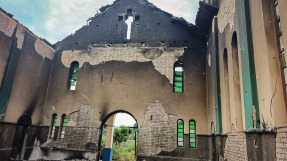
St Julian’s Church in Norwich fell into disrepair in the Victorian era and was restored in 1845. It was partly destroyed during the Blitz in June 1942, when the tower was hit and shortened. The church was restored again after the war. The site of the original anchorite cell has been identified and reconstructed to show how it might have looked in medieval times. A modern stained-glass window at the church depicts Mother Julian in traditional robes, holding her writings, with her famous words “All shall be well” among her visions. Nearby is the Julian Centre, with a bookshop, library, and All Hallows Guesthouse suitable for spiritual retreats.
Memorials
Mother Julian is remembered by Anglicans on 8 May, the day of her first vision. She was never formally canonised but is remembered in the Catholic calendar on 13 May, the day of her recovery. Today, she is recognised across Christian denominations as an important mystic, England’s most famous female visionary, and a significant figure in the development of feminist theology. In recent decades, many books have been written about her, and she is celebrated as a key figure in Norwich’s history and heritage.
Norwich memorials
In 2000, a statue of Mother Julian was erected by the west door of Norwich Cathedral. In 2009, a new bridge over the River Wensum was named Lady Julian Bridge. In 2021, the University of East Anglia opened a new building called the Julian Study Centre.
Upsurge in interest
During the COVID lockdown, there was an upsurge in interest in Mother Julian, as she seemed especially relevant to people experiencing isolation. In 2023, a series of events in Norwich marked the 650th anniversary of her revelations. On Sunday 5 November 2023, she featured on BBC Radio 4’s Something Understood, presented by Mark Tully.
Collect
The Anglican collect prayer for 8 May is:
“Most holy God, the ground of our beseeching,
who through your servant Julian
revealed the wonders of your love:
grant that, as we are created in your nature and restored by your grace,
our wills may be made one with yours,
that we may come to see you face to face
and gaze on you for ever;
through Jesus Christ your Son our Lord,
who is alive and reigns with you,
in the unity of the Holy Spirit,
one God, now and for ever.”