Every Christmas, people sing the song “While Shepherds Watched Their Flocks by Night”. Unlike many other songs and carols that include elements of non-biblical tradition and myth, this song is pure Scripture. It was the first Christmas song authorised to be sung in the Church of England. This is the story …
Brady and Tate
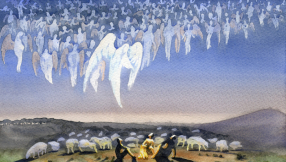
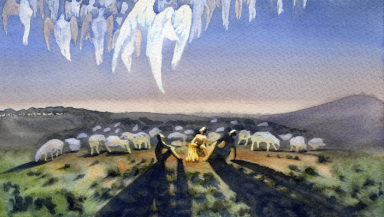
The song “While Shepherds Watched Their Flocks by Night” was written by Nahum Tate. It recounts the angelic announcement to the shepherds from Luke 2:8–14.
Background
During its first three centuries, the Church of England had a rule that only psalms, canticles, and metrical Scripture could be sung in church. After the Evangelical Revival, hymn-singing came to be regarded as a custom of Nonconformists, especially Methodists. It was not until 1820 that the Church of England formally allowed the singing of hymns in church.
Sternhold and Hopkins
Thomas Sternhold was the main author of the first English metrical versions of the Psalms, produced around 1548. Sternhold was Groom of the Robes to Henry VIII and later Edward VI, and he dedicated his Psalter to Edward VI, who reigned from 1547 to 1553. Sternhold died in 1549, and a posthumous edition of his Psalter was published. This contained 37 psalms by Sternhold and an additional seven by John Hopkins. Later, more psalms were added, with settings by John Hopkins, and these were often bound into various editions of the Geneva Bible.
In 1562, the full set of metrical psalms was published by John Day of London. It was the first complete English-language version of metrical psalms. These became known as the Sternhold and Hopkins Psalms. They were extremely popular and were sung widely in churches.
Brady and Tate
In the late seventeenth century, two Anglicans from Ireland worked together to produce a new metrical edition of the Psalms. Nahum Tate (1652–1715) was the son of a Puritan cleric and was born in Dublin. Along with Nicholas Brady (1659–1726), who was from County Cork, he graduated from Trinity College, Dublin. They later moved to England, where Tate became a playwright and Brady became a clergyman in the Church of England. In 1692, Tate was appointed Poet Laureate of England by King William and Queen Mary.
Working together, Brady and Tate produced a new set of metrical psalms and passages of Scripture. Tate wrote most of the poetry, while Brady ensured the theological accuracy.
Their collaboration resulted in A New Version of the Psalms of David, a metrical version of the Psalms. In 1696, this psalter was licensed for use in the Church of England and printed. It went through a number of revisions and further editions over the years. It was printed both separately and bound with the Book of Common Prayer, where it was described as “fitted to the tunes used in the churches”. The edition became known as Brady and Tate (or Tate and Brady). It also became known simply as the New Version, as it gradually replaced the metrical psalms of Sternhold and Hopkins, which then became known as the Old Version.
Some items from Brady and Tate are still regularly sung today, such as their version of Psalm 34, “Through all the changing scenes of life”. In addition to the 150 psalms, they also produced metrical versions of parts of the liturgy and selected passages of Scripture.
Songs and Canticles
After the Psalms, they added several canticles — biblical songs — namely the Song of Mary, known as the Magnificat (Luke 1:46–55); the Song of Zechariah, known as the Benedictus (Luke 1:68–79); and the Song of Simeon, known as the Nunc Dimittis (Luke 2:29–32). In addition, Tate rendered other passages of Scripture into metre for singing. These included the Ten Commandments (Exodus 20:1–20), the Lord’s Prayer (Matthew 6:9–13), the Song of the Angels (Luke 2:8–14), and two passages from Revelation (5:12–13 and 19:6–9).
The Song of the Angels
The most well-known of these metrical Scripture passages is Nahum Tate’s Christmas song “The Song of the Angels”, which begins “While Shepherds Watched Their Flocks by Night”. It was first printed in A Supplement to the New Version of the Psalms, published in 1700. This made it the first — and for a time the only — Christmas song authorised for Anglican worship, at a period when only psalms and canticles were otherwise permitted in church.
Scripture Passage
Nahum Tate based his text closely on the King James Version of Luke 2:8–14.
Verse 8, “And there were in the same country shepherds abiding in the field, keeping watch over their flock by night”, became:
“While shepherds watch’d their flocks by night,
All seated on the ground,”
Verse 9, “And, lo, the angel of the Lord came upon them, and the glory of the Lord shone round about them: and they were sore afraid”, became:
“The angel of the Lord came down,
And glory shone around.”
Verse 10, “And the angel said unto them, Fear not: for, behold, I bring you good tidings of great joy, which shall be to all people”, became:
“Fear not,” said he (for mighty dread
Had seiz’d their troubled mind),
“Glad tidings of great joy I bring
To you and all mankind.”
Verse 11, “For unto you is born this day in the city of David a Saviour, which is Christ the Lord”, became:
“To you, in David’s town, this day
Is born of David’s line
The Saviour, who is Christ the Lord.”
Verse 12, “And this shall be a sign unto you; Ye shall find the babe wrapped in swaddling clothes, lying in a manger”, became:
“And this shall be the sign:
The heavenly Babe you there shall find
To human view display’d,
All meanly wrapt in swathing-bands,
And in a manger laid.”
Verse 13, “And suddenly there was with the angel a multitude of the heavenly host praising God, and saying,”, became:
“Thus spake the seraph; and forthwith
Appear’d a shining throng
Of angels, praising God, and thus
Address’d their joyful song:”
Verse 14, “Glory to God in the highest, and on earth peace, good will toward men”, became:
“All glory be to God on high,
And to the earth be peace;
Good-will henceforth from Heav’n to men
Begin and never cease.”
Tune
At first, Anglicans did not sing the song to the tune most commonly used today. The earliest tune was likely that of the English folk song “Ilkley Moor”. Today, the most common tune in the UK is “Winchester Old”. In the United States, Lowell Mason’s arrangement from Handel’s opera Siroe, known as “Christmas”, has gained popularity. Other tunes include “Cranbrook” and “Sherburne”.
Summary
Today, people sing this song every Christmas, often without realising that it is the most scripturally accurate of Christmas songs, and that for many years it was the only one officially permitted to be sung in a parish church.