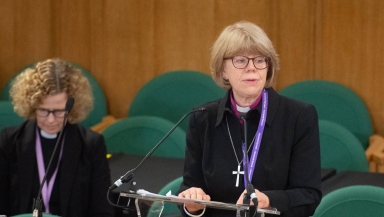
The new Archbishop of Canterbury, Sarah Mullally, has grounds for feeling fairly pleased with her first General Synod as leader of the Church of England. But the divisions in the institution she now leads are likely to get even more bitter during her tenure.
Reasons for her being cheerful are various after the February Synod in Westminster. She got a very warm ovation from the chamber when she announced herself as Archbishop of Canterbury before her presidential address.
The fact that she is the first woman in the role in the history of the C of E undoubtedly contributed to that warmth. But it has to be recognised that her personality is more congenial to Synod members than the somewhat volatile character of her predecessor, Justin Welby. With her public sector background, she is just more their cup of tea than the Old Etonian Welby was.
She was also able to capitalise on the fact that Welby had to resign over his handling of the John Smyth abuse scandal. She was able to strike a note of honesty and reassurance as, with some subtlety, she reminded members of her former role as the Chief Nursing Officer for England:
“I have always, in any leadership role, been committed to accountability and transparency. The way we treat one another, lay and ordained, through our various institutional processes, is vital to the health of our life together in Christ. We have too often failed to recognise or take seriously the abuse of power in all its forms. Robust and transparent processes are central to the health of any institution; proper process around appointments; clear guidelines around conduct and good processes for handling concerns, complaints and whistleblowing.”
She then signalled the failings of the Welby regime: “And nowhere is accountability more imperative than in relation to safeguarding, where in the past we have fallen tragically short. Safeguarding is a fundamental, non-negotiable responsibility, sharpened by our past failings and shaped by the work we still have to do. I am committed to bringing an approach of seriousness and focussed direction to all matters relating to safeguarding in all contexts in the church. This approach must be trauma-informed, put victims and survivors at the heart of all we do and be committed to proper independence.”
It was an emotionally intelligent performance and she was rewarded by generally positive national media coverage. The Guardian reported her address under the headline: “New archbishop of Canterbury vows to build trust in how church tackles abuse”. The strapline over Harriet Sherwood’s story declared: “Sarah Mullally says Church of England has ‘fallen tragically short’ after predecessor resigned over significant failings.”
Archbishop Mullally can also derive satisfaction from the fact that the House of Bishops succeeded in getting their motion to wind down the Living in Love and Faith (LLF) process on sexuality through Synod entirely unamended.
Both conservatives and revisionists tried to beef up the motion their way but the majority of Synod members backed the bishops’ measure to “affirm that the LLF programme and all work initiated by the February 2023 Motion [when Synod voted to allow services of same-sex blessing] and subsequent LLF Motions [including a vote in November 2023 to push ahead with ‘standalone’ or ‘bespoke’ same-sex blessings] will conclude by July 2026”.
So those are her reasons to be cheerful.
Nonetheless, they are followed by the inevitable big 'But' - that the infighting within the C of E on display at General Synod over whether or not the Church should ditch its traditional teaching on sexual morality is set to continue and very probably to escalate in bitterness.
Conservatives are braced to fight an attempt by revisionists to allow clergy to enter into same-sex civil marriages. Unlike the attempt to allow dedicated gay wedding celebrations, this move would not require a two-thirds majority in Synod.
Because it involves civil marriages, revisionists would be able to argue that the change would not affect the Church’s doctrine of marriage and therefore a motion would only require a simple majority. But the fight over the issue is likely to be bitter.
It was also evident from the February Synod that revisionists are becoming increasingly vocal in expressing their view that the Church’s traditional teaching is a safeguarding risk, particularly for LGBT young people.
It is a clever anti-free-speech trick by the revisionists because if a young person self-harms or tragically commits suicide blaming conservative theology, its public advocates become the bogey-people.
With such tactics being deployed, it is little wonder that despite a successful first Synod Sarah Mullally is presiding over an institution in which the hostilities between the warring factions are set to get very personal.
Julian Mann, a former Church of England vicar, is an evangelical journalist based in Lancashire.