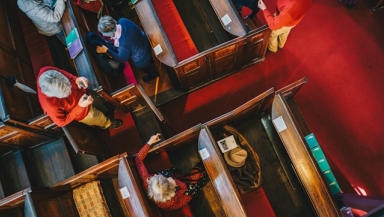
It’s truly encouraging to see so many young people developing a genuine faith in Jesus. However, it’s equally heartbreaking to notice how many are choosing to walk out their faith alone, disconnected from any church community - even Bear Grylls recently claimed that Christians don't need to go to church.
This article isn’t about judgement - it’s a gentle reminder of why the church still matters.
Let’s be honest: the hesitation some people have toward church is not unfounded. The past few decades have brought deeply painful revelations about the church - abuse, manipulation, scandal, and hypocrisy.
On top of that, some churches can feel legalistic and judgemental, sending the message that if you don’t look or act a certain way, you’re not welcome.
Many people have walked away, not from God, but from the institutions that claim to represent Him. And in many ways, the church has failed this generation. But that’s not what the church was meant to be.
What Is the Church?
In the New Testament, the word used for church is “ekklesia,” a Greek term meaning “called-out assembly or gathering of people.” It refers to both the universal Church (all believers across time and space) and local churches (communities of believers who gather regularly). Essentially, the church isn't a building, it’s the people of God.
Thus, if you believe in Jesus, you’re already part of His body (1 Corinthians 12:27), with Christ Himself as the Head (Colossians 1:18). However, what this article is encouraging is for one to belong to a local church. While a deep personal relationship with Jesus is a vital foundation, true spiritual growth happens in community, not in isolation.
The Church Is Family
Life can be beautiful, but it’s also hard. God designed the church to be a spiritual family (Ephesians 2:19; Galatians 6:10; Romans 12:5) - a place where we support one another in trials, rejoice in victories, and walk through ordinary life in community. It’s meant to be a space of belonging and fellowship, not judgement. A place of encouragement, not condemnation. Most of all, it’s where we learn to love.
The New Testament is filled with “one another” commands: Love one another (John 13:34-35), bear one another’s burdens (Galatians 6:2), encourage one another (1 Thessalonians 5:11). These can’t be practised alone. Love is, by nature, relational. As Ecclesiastes 4:9–10 reminds us: “Two are better than one... If either of them falls down, one can help the other up. But pity anyone who falls and has no one to help them up.”
The Church Helps Us Grow
The church also serves the core function of providing a sacred space of communal worship and prayer (Acts 3:42-47), which honours God and strengthens the Christian’s life and identity. But it isn’t just a social club or a weekly service, it’s where the Great Commission of discipleship happens.
Yes, we come as we are, but we should not stay as we are. I know this is a tough one to digest. In the Gospels, we see that Jesus didn’t just save the disciples, He spent time transforming them. In the same way, we are called to grow and to be challenged. That happens in the church - through teaching, correction, and guidance from Scripture, pastors and mature believers. Scripture states in Proverbs 27:17, “As iron sharpens iron, so one person sharpens another.”
The church helps guard against spiritual stagnation and provides us with accountability in living out our faith. What a privilege it is to have a fellowship of believers to walk with us on our path of faith, especially in times of crisis or weakness.
And this process doesn’t stop with us - we grow together in the Lord so that we can help others grow in their relationship with the Lord. We are discipled in order to disciple others. There is no better place for discipleship to take place - and be sustained - than in the church. Without that fellowship of believers it is so much easier to be swayed, tempted, or simply give up.
The Church Is a Place of Purpose
Like I outlined earlier, the church is a gathering of the “called-out.” In other words, it is the gathering place for those who have been chosen to carry forward the message of Jesus. You were saved for a reason. In the church, you discover your God-given gifts, learn how to use them, and step into your calling - not just for your benefit, but for the serving of others and building of God’s kingdom (1 Corinthians 12:4-7; Ephesians 4:11-12; 1 Peter 4:10). Your purpose unfolds in community. You were never meant to figure it all out on your own. Within the body of Christ you will find a wealth of wisdom in the faith and an abundance of life experience - people who have been through it all and stayed the course, people who are ready to give you really sound advice when you need it and pray together with you as you seek to discern God's will. Who wouldn't want that?
No Church Is Perfect - But God Still Uses It
The church is made up of broken people. That’s why it’s messy sometimes. But Jesus didn’t give up on the church. In fact, He “loved the church and gave Himself up for her” (Ephesians 5:25). Hence, neither should we give up on the church. We've all heard the phrase "Be the change you want to see" and, yes, sometimes we can feel like we've heard it one too many times. But there's real wisdom in these words. Rather than walking away, can we be the ones to roll up our sleeves and put in the hard work of building the Church God wants to see in this world? That can't happen if we're not a part of it.
As Jesus said in Matthew 7:16 and 20, “By their fruit you will recognise them.” A healthy church bears good fruit. It reflects God’s kingdom - diverse people, united in love and truth, showing the world that God's grace is real and powerful.
So, please, find a church. Not just any church, but a Christ and Bible-centred one that values God’s love, discipleship, and integrity. Pray about it. Ask God to guide you.
Don’t let fear, doubt, or even pride keep you on the sidelines. As Author Dr Don Raunikar wisely put it: “Proud people work on their own initiative. They want to obey only their own self-exalting impulses. Humility, on the other hand, sees the value of the larger group, the church, or the family unit. Pride sees only the individual.”
The truth is: you need the church, and the church needs you.