Mankind has always been drawn to look at the moon. The Moon’s creation was explained in the book of Genesis, and the moon plays a vital role in setting the dates of religious festivals. This is the story …
The word “moon”
The word moon is Anglo-Saxon in origin (mōna) and gives us the words moonlight, moonbeam, and moonstruck. Originally, the word moon just referred to the lunar object visible in the Earth’s night sky. It was not until the invention of the telescope that astronomers were able to detect objects orbiting other planets, and then the use of the word “moon” was extended to describe these as well.
In 1610, Galileo Galilei spotted four objects orbiting Jupiter. The four moons around Jupiter are known as the Galilean moons and were named Io, Europa, Ganymede, and Callisto. In 1655, a moon around Saturn was discovered by Huygens and named Titan. The moons around the other planets are given names, but our Moon has no name in English.
Moons in the solar system
Astronomically, a moon is a natural satellite that exists in a stable orbit around a celestial body, usually a planet. In our solar system, the number of moons tends to increase the further you get from the sun. Mercury and Venus have no moons; Earth has one; Mars has two; but when we get to Jupiter and Saturn, astronomers are still finding more. Jupiter may have about a hundred, and Saturn may have three hundred. Some moons, like Titan around Saturn and Triton around Neptune, seem to have their own atmospheres. Other moons are thought to be asteroids pulled into orbit around a larger planet by its gravity and are sometimes called moonlets.
The moon as a god
Ancient peoples saw the sun, moon, stars, and planets as lights in the sky, and many treated them as gods. Before the advent of the telescope, ancient peoples could only see five planets: Mars, Mercury, Jupiter, Venus, and Saturn. In biblical times, and in other ancient religions such as those of the Sumerians, Akkadians, Babylonians, Egyptians, Assyrians, and Greeks, the Moon was worshipped as a god or goddess. People believed these gods determined events on Earth, and so they developed astrology.
Roman god Luna
The Romans had the moon goddess Luna. This, in turn, gave us the English word “lunar”. Its connection to light gives us the words lumen, lucid, illuminate, and even lunatic. The English word lunar is used as a technical adjective for the moon, and we say “lunar eclipse” to refer to an eclipse of the moon.
Monday
The days of the week in many languages are named after objects visible in the sky. In English, we have the sun’s day, or Sunday, which is Sonntag in German. The sun’s day (Sunday) is followed by the moon’s day, or Monday, which is Montag in German. Likewise, from the Latin word luna, Monday is called lundi in French, lunes in Spanish, lunedì in Italian, and dydd Llun in Welsh.
Days and years
Ancient people used the sun and moon to set their calendar and mark the seasons and time. A day is the time it takes for the Earth to rotate fully on its polar axis as it orbits the sun, divided into daytime and nighttime, while the Moon orbits the Earth. In ancient times, when people counted in base 12, these two phases were each divided into 12 parts, which they called hours. Put together, this gives 24 hours. It is not correct to say that a day is literally 24 hours; rather, a day is divided into 24 hours. In this modern world of clocks and watches, the day and the hour have been standardised for convenience.
Months
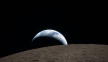
The moon takes just over 27 days to orbit planet Earth and return to the same place, and it takes about 29 and a half days to rotate on its own axis through the cycle of all its phases - from a new moon to a crescent moon to a half-moon and back to a new moon. The time it takes for the moon to rotate on its own axis is called a month, from the word moon; similarly, in German it is a Monat. In English, some people say “many moons ago” instead of “many months ago,” and the first month of marriage is called the “honeymoon period”. Because it takes the moon about the same time to orbit Earth as it takes to rotate on its own axis, we never see the far side of the moon, and we only see about 59% of its surface in total. The far side of the moon was first seen by Luna 3 in 1959, then by astronauts on Apollo 8 in 1968, and more recently by astronauts on Artemis II.
Creation of the Moon
The creation of the Moon is detailed in the Bible in the first chapter of Genesis. This explains why it was created but, perhaps annoyingly, does not go into the astronomical details of how. The moon makes its appearance in the creation account when God said, “Let there be lights in the expanse of the heavens to separate the day from the night” (Genesis 1:14a). Here, the Bible tells us about the creation of the moon, which is the light that separates day and night.
Moon as a sign
The text continues: “and let them be for signs, and for seasons, and for days, and years: and let them be for lights in the firmament of the heaven to give light upon the earth: and it was so” (Genesis 1:14b–15 KJV).
For the Israelites, the moon’s cycles defined the months and festivals. New Moon observances began each Hebrew month with sacrifices and trumpets (Numbers 28:11–15). The psalmist sang, “He appointed the moon for seasons” (Psalm 104:19). For the Jews, a month was marked “from new moon to new moon” and a week “from Sabbath to Sabbath” (Isaiah 66:23).
Moon as the lesser light
Then the Genesis account reads: “And God made the two great lights; the greater light to rule the day, and the lesser light to rule the night: he made the stars also” (Genesis 1:16 KJV).
This seems odd to us because we know that the greater light, which we call the sun, is a light-emitting object, but the lesser light, which we call the moon, is not literally a light because it does not emit light. However, the moon reflects the sun’s light, and it was a light in the sense that it gave light.
Moon to rule the night
“And God set them in the expanse of the heavens to give light on the earth, to rule over the day and over the night, and to separate the light from the darkness. And God saw that it was good” (Genesis 1:17–18).
The creation account in Genesis 1:14–19 explains why God created the celestial objects as signs to indicate the passage of time. In Genesis, the celestial objects are created by God but are not gods themselves. This contrasts with other religions, which saw the sun, moon, stars, and planets as gods in their own right. This is, perhaps, some of the theology behind it.
The lights “ruled” in the sense of measuring time, not in the sense of dictating events on Earth. Even in English, the word “ruler” can mean a tool of measurement or a person who orders events. Astrology ascribes powers to the stars and planets that rule our lives as gods, but the Bible does not. Ancient peoples worshipped the stars, but God instructed his people: “You shall not make for yourself a carved image, or any likeness of anything that is in heaven above” (Exodus 20:4).
In 2 Kings 23:5, we read that pagan priests burnt incense “to Baal, to the sun and the moon and the constellation”. By contrast, in Psalms we read that the “sun and moon praise him” (Psalm 148:3).
The lunar calendar
The moon takes about 29 and a half days to complete its cycle, and it does that twelve times within a year, which is just over 354 days. By comparison, a solar year - how long it takes the Earth to orbit the sun - is about 365 and a quarter days. So, the difference between a solar year and twelve lunar months is about eleven days per year. Meton of Athens worked out that the solar and lunar cycles line up every 19 years, when 19 solar years are almost exactly 235 lunar months. He used this to adjust the Athenian calendar in 423 BC.
Some calendars, like the Jewish and Ethiopian calendars, keep the lunar months but adjust the calendar to fit the solar year, creating a hybrid solar–lunar system. The Ethiopian calendar has 12 months of 30 days, and the last month, called Pagume, has five days, or six in a leap year. As a result, Ethiopians like to claim that they have “13 months of sunshine”.
Our Western Gregorian calendar, based on an adjusted Roman Julian calendar, is a solar calendar with twelve months, but they are not pure lunar months. By contrast, the Muslim calendar is purely lunar, with twelve months based on the sighting of the new crescent moon. This causes festivals like Ramadan to shift through the seasons over 33 years.
The Jewish calendar
In the Old Testament, the Jewish calendar follows a lunar cycle, and the phases of the moon mark the start of festivals. The Jewish New Year (Rosh Hashanah) begins at a new moon. The Day of Atonement (Yom Kippur) follows with a waxing moon. The Feast of Tabernacles (Sukkot) is a full-moon harvest festival. Passover is a spring festival that begins on the night of a full moon after the northern vernal equinox (Exodus 12:1–2), and Pentecost (Shavuot) depends on the date of Passover. So, the Jewish year revolves around the moon. Months alternate between 29 and 30 days based on the new moon. However, to stop the calendar from getting out of sync with the seasons, the Jewish calendar adds an extra month before Adar (called Adar I) seven times in every nineteen years, in what is called the Metonic cycle.
New Testament
In the New Testament, many Christians from a Jewish background continued to mark the festivals by the moon, but Gentile Christians often did not. St Paul felt it necessary to write to the church at Colossae: “Let no man therefore judge you in meat, or in drink, or in respect of a holy day, or of the new moon, or of the sabbath days” (Colossians 2:16 KJV).
The Moon and Easter
When the early Church discussed how to date Easter, they wanted it to fall on the first Sunday after the first full moon after the northern vernal equinox, following Passover. The early Christian world agreed on a complicated formula for determining Easter Sunday, taking into account the Metonic cycle. This was approved 1,700 years ago by the Council of Nicaea in AD 325. Sadly, different interpretations of this have led to Easter being celebrated on different Sundays in the Orthodox world and in the Catholic and Protestant world. Whichever calculation is used, the Moon is a factor in deciding the date of Easter, and it sets much of the Christian calendar, because the dates of festivals such as Ash Wednesday, Lent, Good Friday, and Pentecost move with Easter.
Conclusion
God created the Moon to serve us, but not to be worshipped. The Genesis account explains why the Moon was created but not how, and it contrasts God as the creator with other religions, where the Moon, sun, and stars were seen as gods themselves. As explained in Genesis, the Moon still divides daytime from nighttime; it is still used to mark the seasons, days, and years; and it still lights up the night. Even today, the Moon is used to determine the timing of Jewish and Muslim festivals and Easter, and the ecclesiastical calendar revolves around it. We even have a day of the week named after it.