It has been a year since militant group M23 took the city of Goma in the Democratic Republic of the Congo (DRC), but despite trauma and suffering, God is reportedly at work.
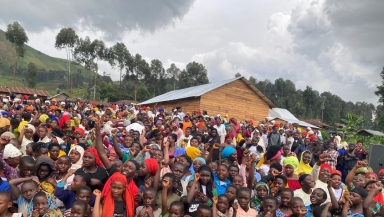
It is believed that over 3,000 people died following the capture of Goma, while 700,000 people were forced to flee their homes. Executions, rapes and kidnappings also followed as did the closure of key infrastructure like banks, courts and the airport.
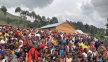
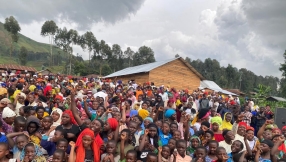
However, the Anglican Bishop of Goma, the British-born, Martin Gordon, said that the city has witnessed a Christian awakening, with thousands of people turning to Jesus.
Christian ministers in certain parts of sub-Saharan Africa often cite the difficulty of visiting all parts of their parish as a real challenge in ministry. Large areas, scattered communities and limited transport and infrastructure make it difficult for everyone to get the spiritual care they need.
Bishop Gordon told the Church Mission Society, “There were parishes that we been unable to reach for three years, but this year we’ve been able to visit and encourage the people that they are not forgotten.
“The suffering in Goma seems to have captured the attention of many in the Church globally, and we have been overwhelmed by the generosity of churches and individuals. As a result, when the situation was at its toughest, we were able to give a cash gift to each of our staff and clergy and even our teachers who hadn’t been paid for six months because of the closure of the banks.
"And again, at Christmas we blessed 200 families with a gift of a chicken and a sack of rice to celebrate.”
M23 is backed by the Rwandan government, which according to the DRC has designs on its resource-rich eastern territories. For their part, Rwanda claims that the DRC is harbouring individuals wanted in connection with the 1994 Rwandan genocide.
Added to this are Islamist groups who, taking advantage of the conflict between the DRC government and M23, have managed to conduct atrocities of their own.
In such a society, Bishop Gordon said that churches were one of the few institutions in the DRC that generally hold the people’s trust.
“It is at the heart of every village and community. When war came, people looked to the churches for every kind of help, as well as for hope," he said.
"They were used as shelters, as distribution centres and we saw an increased attendance in many of our parishes that were not displaced.
"Those who didn’t usually attend started coming for prayer. Those who were more sporadic started attending more regularly.”
He said that in 2025 increasing numbers were asking to be baptised and confirmed but conceded that life was still tough in the region.
“Times are incredibly hard in Goma right now," he said.
"The 2025 invasion adds one more layer of trauma to more than 30 years of conflict. And many still struggle to make ends meet. But amidst the suffering, we testify daily to God’s faithfulness, and we continue to put our trust in him, as the one who will ultimately bring about peace.”