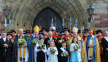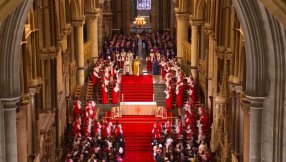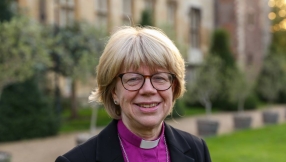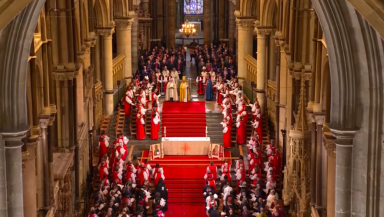
On 3 October 2025, the world was told that Sarah Mullally had been selected to be the 106th Archbishop of Canterbury. Twenty-five weeks later, after numerous ceremonies including last week’s ‘Installation', she can finally get on with the job.
One man who has been on this journey with her is Joaquin Philpotts, an industrial engineer and lay-minister from Buenos Aires. As was one of five representatives of the Anglican Communion on the Crown Nomination Commission, he spent last summer deliberating over different candidates. In January, he was called to offer part of the ‘Charge’ at the confirmation of Sarah Mullally’s election and last week he was there at Canterbury Cathedral to see her installed.
His ‘charge’ was simple’ – “As an Instrument of Communion, you are called to minister personally and pastorally to all member churches of the Anglican Communion, especially in collegial partnership with your fellow Primates.”
Yet, as previously reported, the ‘collegial partnership’ of the Anglican Communion is strained, if not broken, with the leaders of twelve of the forty-two provinces boycotting the Installation. More than a quarter of the Anglican Communion’s provinces can no longer “walk together” in the way Sarah Mullally’s predecessor hoped.
Speaking before the service Mr Philpotts, a member of the Church of South America, whose primate was in Canterbury, reflected on the challenges that face Archbishop Mullally.
“I think we are in a very special moment. We’ve got to keep looking to work together but we cannot walk on opposite sides of the street. We’ve got to face our problems – we have to agree what are problems are and look how to solve them … I am hearing a lot about unity, but we cannot have unity without order," he said.
Mr Philpotts suggested that while it might be that both those in favour of same-sex blessings and those against might be wrong in part, it is not possible for both to be right.
“It is a doctrinal issue, and it is important,” he said, “and that is why I think we cannot keep walking together forever. We have to solve our differences based on the word of God and we can’t think forever that we both believe in the word of God but we interpret it different. The word of God was inspired by the same Holy Spirit.”
Referring to Jesus' words in Matthew 15:12-14, Joaquin warned that Jesus said there will come a time when "He will take out from the root whichever he didn’t like. So that is a huge responsibility for us.”
At the moment, Mr Philpotts is committed to the Nairobi-Cairo Covenant and the other proposals which the Anglican Consultative Communion will be discussing this summer. He is not convinced by Gafcon’s new Global Anglican Communion, seeing it as a “break” in the Communion, which could just lead to further splits.
Instead he said, “I think we’ve got to focus on Jesus Christ and the Holy Spirit and understand that the Nairobi-Cairo proposals to broaden the leadership is not a solution … it is not only the leadership’s responsibility. Whatever way it broadens, it is not only that, they will have to solve the problems – we all have to solve the problems.”
Yet, even at his most optimistic, Philpotts still admitted that, if there are some in the Anglican Communion who will not come back under the word of God, there may come a time when “we do have to break apart, but we will have to take a lot of responsibility".
Despite his fears, there was a freshness in the way that Philpotts spoke that perhaps comes from being part of a Province which has gone through something of a transformation over the past forty years. What was once the preserve of Anglo Argentines, with formal services predominantly in English, has now shifted to reflect Spanish Argentinian culture.
More than that, there has been a spiritual awakening - the gospel is being proclaimed and there has been rapid numerical growth. The expat English community is now seen as “an opportunity” for evangelism.
So, it was unsurprising that his prayer for the Archbishop of Canterbury as she begins her new ministry is simple: “My prayer for her, my personal and special prayer is that she preaches a bold gospel. Bold, not bold preaching, but the preaching of a bold gospel – we have to let the world know about the gospel.”
Susie Leafe is director of Anglican Futures, an organisation that provides pastoral and practical support to orthodox Anglicans.