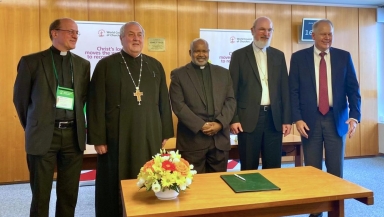
A memorandum of understanding has been signed by the World Council of Churches (WCC) and the Global Christian Forum affirming the unique roles they have to play in their mutual quest for Christian unity.
The agreement states that "exchanging faith stories of individuals and their churches and perspectives on shared concerns helps Christians to recognize Christ in one another and one another in Christ, to see the communities they represent as places where faith is expressed and nurtured, and, on the basis of new or renewed relationship, to address together matters of common interest".
As part of the agreement, the WCC has committed to making an "undesignated" financial contribution annually.
The memorandum of understanding was signed by Fr Andrzej Choromanski, of the Pontifical Council for Promoting Christian Unity, the WCC's Rev Prof Dr Ioan Sauca, Rev Dr Casely Essamuah of the Global Christian Forum, Bishop Thomas Schirrmacher of the World Evangelical Alliance, and William Wilson of the Pentecostal World Fellowship.
The WCC said the document was the fruit of many years of discussions and "marks an historic milestone in the longtime collaboration between the two organisations".
Dr Sauca, WCC acting general secretary, said, "We rejoice in the existence and in the witness of the Global Christian Forum to our common calling to bear witness together to the reconciliation and unity of all things in Jesus Christ, God and Saviour.
"We pray that the Global Christian Forum will be blessed in its service to Christian unity."
The Global Christian Forum was established in response to a call from the WCC 8th Assembly in 1998 to create a new space for Christian unity.
The intention was to provide a platform for churches and communities that did not wish to be members of the WCC.
Dr Essamuah, secretary of the Global Christian Forum, said the agreement was a "recognition that the calling for Christian unity requires, indeed deserves, more than one expression of ecumenical commitment and cooperation".
He said it also recognised the pivotal role of the four pillars, "namely the WCC, World Evangelical Alliance, Pentecostal World Fellowship and the Roman Catholic Church through the Pontifical Council for Promoting Christian Unity".
Dr Essamuah added: "We look forward to the future with great hope as we all work to advance progress on the church's calling to pursue Christian unity."
Bishop Schirrmacher, WEA general secretary, said, "As one of the pillars, we want to be involved, and we want to be part of giving this space."
Fr Choromański said, "There is a need to have this space which has been conceived.
"This memorandum of understanding is the fruit of many discussions. We will continue to be a part of the Global Christian Forum and we see the future of this unifying platform."
Dr Billy Wilson, chairman of the Pentecostal World Federation, called the Global Christian Forum "a healthy place of dialogue, relationship-building, and love".
"What I've found in the Global Christian Forum is a great place for dialogue—but an even better place to make friends and share the love of Jesus with one another," he said.