Britain is really odd. We proudly boast of being the home of the Mother of Parliaments, and have – rather reluctantly, admittedly – exported democracy around the world. On the other hand, its huge size has rendered our House of Lords an international laughing-stock (at around 800, second only to the Chinese National People's Congress).
Furthermore, while we are resolute in our defence of freedom of religion, no less than 26 seats in the Lords are reserved for Anglican bishops, the Lords Spiritual. They are the archbishops of Canterbury and York, the bishops of Durham, London and Winchester, and 21 of the longest-serving bishops from elsewhere. To try to achieve a measure of gender balance, for the next few years all vacancies will be filled, where possible, with women, regardless of seniority.
A really serious attack on the bloated size of the Lords has now been launched and reform is finally getting somewhere. The Burns Committee on reducing its size produced a widely welcomed report in October last year. This week the prime minister has written to the Lord Speaker, Norman Fowler, saying: 'I intend to continue with the restraint which I have exercised to date and, when making appointments, to allocate them fairly, bearing in mind the results of the last general election and the leadership shown by each party in terms of retirements. I will also operate on the basis that there is no automatic entitlement to a peerage for any holder of high office in public life.'
All well and good, but as the Law and Religion blog points out, this has consequences. The Burns report makes no recommendations about the Lords Spiritual, but obviously if the Lords is reduced in number and their own numbers are not, they provide a larger proportion of its members. It might be argued that this returns them to the status quo ante the swelling of numbers in recent years; or it might not. Either way: the historical anomaly of bishops having the right to make our laws just because they're bishops is being brought into sharper focus again – and in the current climate, arguing for their retention at all is a pretty tough gig.
So this is arguably a time for the CofE to demonstrate a willingness to change before change is forced on it. Full disclosure: I'm a Baptist. I don't believe in state churches. I believe in freedom of religion, so I don't believe any religion should be privileged above another. And that's what we have: not just one religion, but one denomination of one religion, gets to be part of our legislative process not because anyone really believes it should, but because that's the way it's always been. It's hard to imagine anything in principle less defensible.
However, when it comes to politics, the British have an aversion to principle. We don't like grand systems, like the French. Our only attempt at revolutionary change – chopping King Charles' head off and establishing the short-lived Commonwealth, for which my own spiritual ancestors were notably enthusiastic – was a failure. We tend to ask of something, not 'Is it right?' but 'Does it work?'
So, while the establishment of the Church of England is in the eyes of a good Baptist a theological monstrosity and we wouldn't start from here, it's worth asking what is worth preserving from the current arrangements.
One of the arguments sometimes used in favour of having bishops in the Lords is that they represent all denominations and all religions; we don't need to worry about the voice of 'faith' being heard in Parliament, because the Anglicans will do it for us.
That is, to say the least, more than a bit patronising.
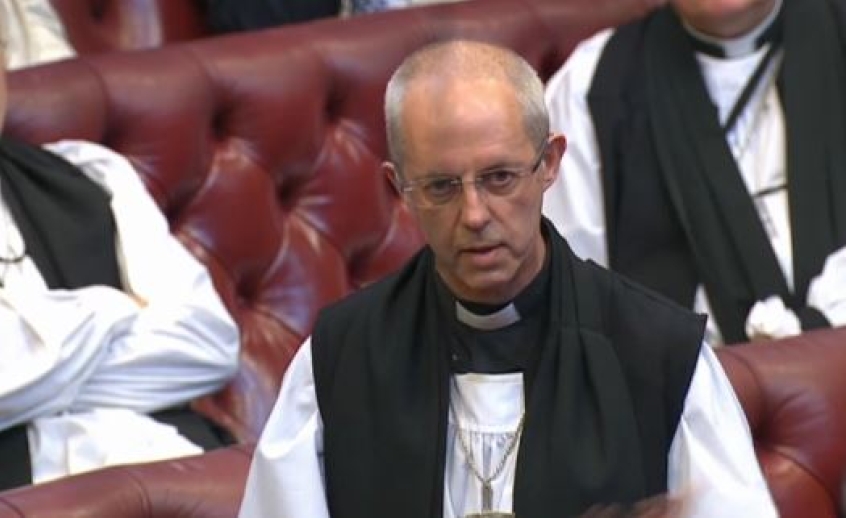
However, the idea of there being religious representation in the Lords – if it could be made more representative – is not in itself a terrible idea. Voices of faith can add value to the democratic process of lawmaking. They are a corrective to a purely utilitarian philosophy of the greatest good for the greatest number. They remind lawmakers of a wider thought-world. They represent a continuity with our ancient customs that is congenial to our way of doing things.
It would be entirely possible for the CofE to cede some of its privileges in this respect, to agree a voluntary reduction in the number of bishops and suggest instead the inclusion of representatives of other churches – perhaps through Churches Together in Britain and Ireland. It is not beyond our communal wit to include representatives of other faiths, as well.
If we are happy to continue with a House of Lords whose members inherit their positions as descendants of Norman invaders or are randomly awarded them on some kind of merit, we might think it's still worth including religious representatives as part of the mix.
In theory, of course, and with a delightful irony, one of them might even be a Baptist, creating a theological quandary it's probably impossible to resolve.
Follow Mark Woods on Twitter: @RevMarkWoods