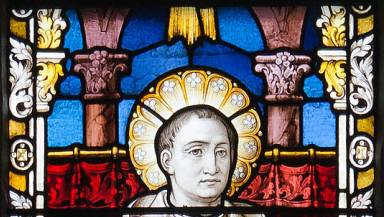
The question of God's existence has been a central topic of philosophical and theological debate for centuries. Let us take a look at some of the most compelling arguments offered by one remarkable thinker.
Thomas Aquinas, a prominent medieval philosopher and theologian, presented five distinct arguments, often referred to as the Five Ways, to demonstrate the existence of God. These proofs offer different perspectives and lines of reasoning, aiming to provide a rational foundation for belief in a divine being.
1. The First Way, also known as the Argument from Motion, asserts that everything in the universe is in motion and requires a prior mover. This chain of motion cannot regress infinitely, leading to the necessity of an unmoved mover, which Aquinas identifies as God.
2. The Second Way, the Argument from Efficient Cause, posits that every effect has a cause, and tracing causes back leads to a necessary First Cause, which is God.
3. The Third Way, the Argument from Contingency, focuses on contingent beings – those whose existence depends on something else. As there cannot be an infinite chain of contingencies, there must be a necessary being that causes all others, and that being is identified as God.
4. The Fourth Way, the Argument from Degree, suggests that things possess varying degrees of qualities (such as goodness, truth, and beauty). There must be a standard of utmost perfection that these degrees refer to, and that standard is God.
5. The Fifth Way, the Argument from Design, examines the intricate order and purpose observed in the universe. Aquinas argues that this order implies an intelligent designer, which he identifies as God.
While Aquinas' proofs have been influential and are still studied today, they have also faced criticisms and counterarguments. Some critics challenge the premises, question the necessity of a single unmoved mover or first cause, or propose alternative explanations for the observed phenomena.
Thinking objectively, whether one finds Aquinas' arguments compelling or not, the exploration of these proofs and their philosophical implications can indeed be thought-provoking and potentially transformative.
Any Christian evangelist seeking to win converts or even to hold their own in a serious theological debate would do well to swot up on these postulates. Delving into Aquinas' Five Ways allows individuals to engage with profound ideas about the nature of existence, causality, order, and purpose in the universe.
Thomas Aquinas was born in Sicily in 1225 and died before he reached 50 years of age in 1274. His contribution to the academic field of theology remains remarkable.
Duncan Williams is outreach director for the Christian Free Press and has worked for Son Christian Media here in the UK and Recovery Network Radio in the United States. He is an ordained minister and a long-term member of Christians in Media. He provides content and syndicated news for regional publisher www.tindlenews.co.uk