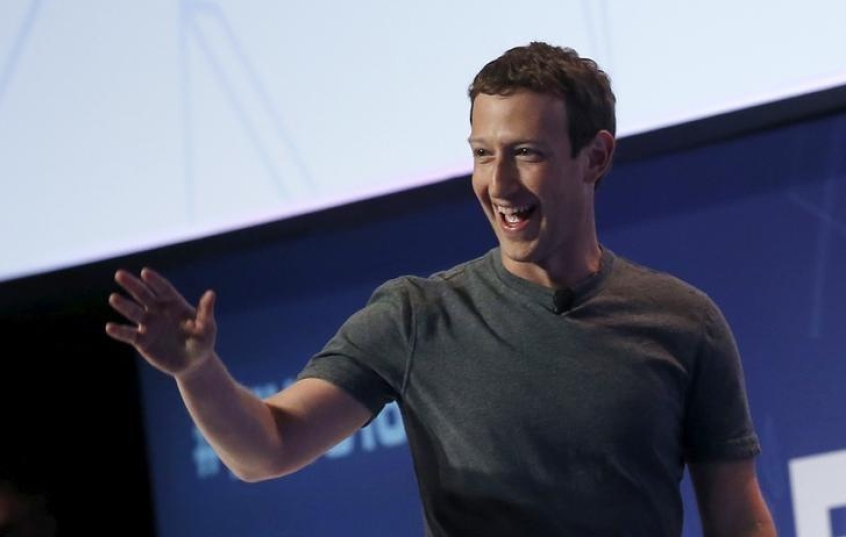
Facebook CEO Mark Zuckerberg has suggested that Facebook can act like a type of church for its users.
Zuckerberg claimed that as church attendance declines, the social network site he established can offer that same sense of community that worshippers normally get from church.
This is part of Facebook's new mission statement, which is to 'Bring the world closer together.' Consequently, Zuckerberg hopes Facebook can be an enabler of community and even encourage people to be more active in volunteering and in charitable work.
What is more, Zuckerberg is aware that community does not simply happen, it needs to be nurtured and guided. He sees the church with its pastor as a prime example:
'Think about it. A church doesn't just come together. It has a pastor who cares for the well-being of their congregation, makes sure they have food and shelter...leaders set the culture, inspire us, give us a safety net, and look out for us. Communities give us that sense that we are part of something bigger than ourselves, that we are not alone, that we have something better ahead to work for.'
So Facebook as church and presumably someone like Zuckerberg as its pastor? What should we think about that?
On the one hand, Zuckerberg is right. People are happier in communities. People who belong to churches, clubs, and associations generally tend to be more active in life, and even happier overall.
In addition, the internet has revolutionised the way people do Christianity and church in the 21st century. You can stream church services live, listen to sermons on-line, subscribe to podcasts, join common interest groups on Facebook and interact any number of ways on various social media platforms.
But I have my doubts.
First, social media can create a docetic community, but not an authentic community. The heresy of 'docetism' is the belief that Jesus did not have a real physical body. Applied to the Church, the collective body of Christ, a docetic the view of the Church is that it does not require physical presence, touch, and embodiment. It is the mistaken view that unity is all about our common beliefs and shared interests. But Christianity has always declared that our invisible unity achieved through the Holy Spirit must be visibly expressed in sharing the holy kiss (or shaking hands), coming around the table of bread and wine, laughing and crying together, practising hospitality and blessing one another through the exercise of diverse spiritual gifts. While social media is a great supplement to church life, it is not a substitute for church life. So, no, social media will never ever be your church.
Second, I do have some grave concerns about any organisation that aspires to function as a church and to identify its leaders as the equivalent of clergy. If Facebook is a church, does that mean it wants our worship? If Zuckerberg is a pastor, does he intend to instruct us in all things divine, seek to give us spiritual counsel and shape our ethics? For those of us with a more catholic sensibility, can we seriously imagine Facebook mediating divine grace and Zuckerberg embodying the authority of Christ? I hope not.
I love my Facebook account. It is a great way to catch up with friends and connect with my former students. But I'm just not prepared to worship in it or offer worship to it. And while I think Zuckerberg is a great tech entrepreneur, he's no St Anthony, not even a Rick Warren. So, no, he'll never be my pastor.
My advice: be wary of any organisation that aspires to be your personal prophet in order to make a corporate profit.
Rev Dr Michael Bird is Lecturer in Theology at Ridley College in Melbourne, Australia. He is the author of 30 books in theology and fiction. He blogs at Euangelion and can be followed on twitter @mbird12.