Don't be afraid to talk about the devil, Billy Graham told an enquirer on his regular question and answer page.
He was responding to a questioner who said: "I don't know if I'm right, but it seems to me that we used to hear a lot more about the devil than we do today. Was talking about the devil just kind of a passing fad?"
Graham replied that "Satan is real, and he is just as much at work today as he was a few decades ago. The Bible's warning is still true: 'Your enemy the devil prowls around like a roaring lion looking for someone to devour' (1 Peter 5:8)."
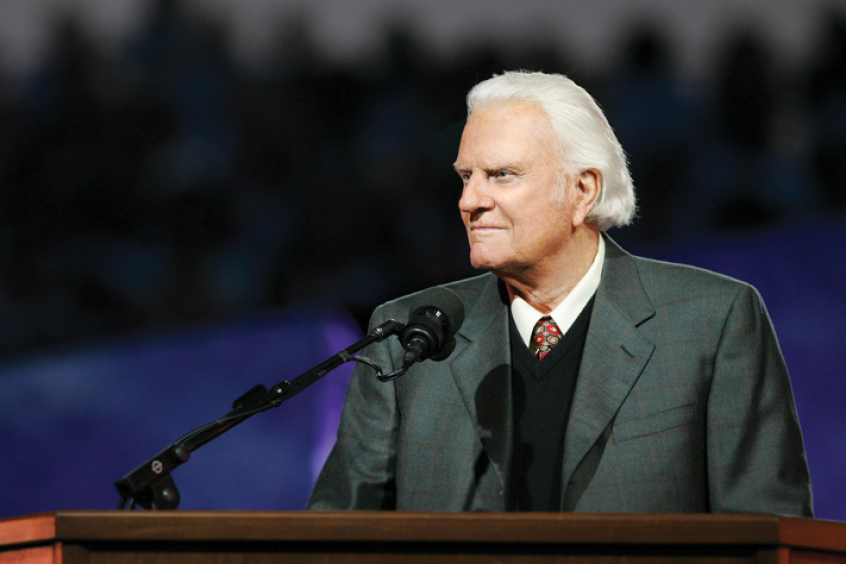
He continued: "While we should never make the devil the sole focus of our attention (for only Christ is worthy of that honor), we do need to be alert to his schemes and on guard against his attacks."
Satan's aim is to block God's plans in every way he possibly can, Graham said, often working in "hidden and subtle ways". The devil definitely exists, he said, and "he'll do everything he can to keep you from Christ and His will for your life".
He concluded by saying: "Resist the devil, and he will flee from you. Come near to God and he will come near to you" (James 4:7-8).
Graham's questioner probably had it right, though, when he said Christians used to talk more about the devil than they do now. Belief in Satan is less commonly expressed than it was. It may have something to do with Hollywood, and Christians' fear of seeming to say they believe in those ridiculous caricatures invented by the film industry.
We don't have to believe in the Satan of The Witches of Eastwick or The Devil's Advocate, or even Bedazzled. In fact, we can be sure he looks nothing like Jack Nicholson, Al Pacino or Peter Cook. And declining to picture him at all is a sign of spiritual maturity, because giving shape to something limits it (one reason the Hebrews so fiercely rejected images of Yahweh). Once we picture the devil as one thing – a goat-headed figure with a trident and red tights, perhaps – a lot of other things become less devilish: poverty, cruelty, racism, hunger, disease, selfishness, rage, spite; all the things that disfigure human beings in their relationships with each other and with God.
But when we lose the sense that evil can be truly personal, and that we face a spiritual adversary, we have lost a significant insight from Scripture and the experience of God's people down the ages. That's not to say it is necessarily helpful to think too much on this subject or to speculate too deeply. But neither is it helpful to imagine belief in the devil is a superstition from the childhood of the world which we have simply outgrown.
Famously, CS Lewis wrote in The Screwtape Letters: "There are two equal and opposite errors into which our race can fall about the devils. One is to disbelieve in their existence. The other is to believe, and to feel an excessive and unhealthy interest in them. They themselves are equally pleased by both errors, and hail a materialist or magician with the same delight."
Follow Mark Woods on Twitter: @RevMarkWoods