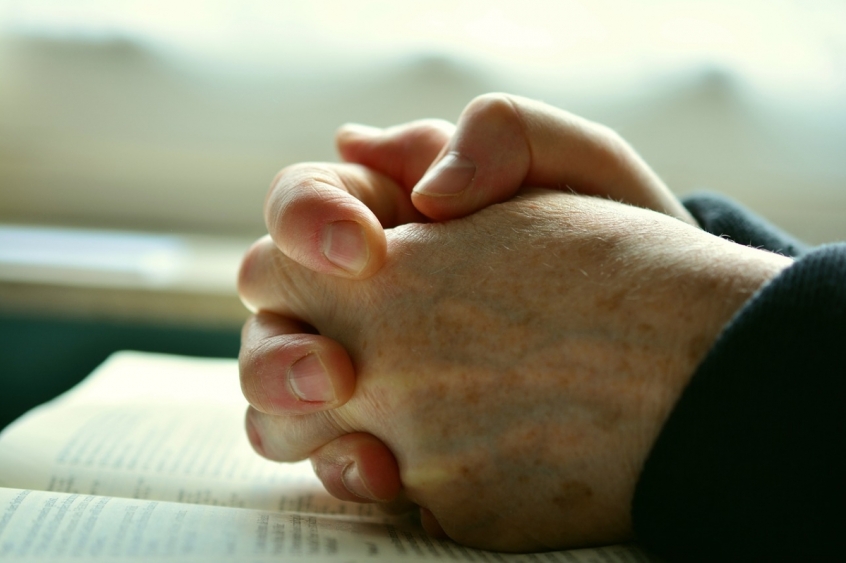
I was delighted to discover that, far from being a relic of the past, prayer is proving an invaluable resource for people struggling to cope with the current pandemic. The latest Tearfund study, which shows nearly half the population of the UK is availing itself of this precious gift, is both heart-warming and hopefully a harbinger of future blessing. But prayer can and should be infinitely more than a 'pandemic crutch' offering us temporary support until we can all return to a more normal life.
I certainly wasn't expecting this kind of response to the survey, but what really surprised me was the fact that it was younger adults rather than the over-55s who were willing to admit they are most likely to pray on a regular basis. All of which led one church leader to write on Facebook this week that even a few months ago he could never have imagined a headline in a major British paper that reads "British public turn to prayer as one in four tune into religious services on line" and carried this equally "stunning" subtitle "Young people lead resurgence in faith".
This renewed interest in prayer got me wondering how this growing number of people are framing the content of their prayers. I guess the Lord's Prayer might figure highly if they have repeated it frequently in school assemblies. But I really do hope we can find ways of telling them that when we get to know God in a personal way we can, and ought to be completely honest with Him.
Take Psalm 44, for example. It is perfectly obvious that the author was in a very agitated state. He simply couldn't figure out why God had allowed His people to become a laughing stock. As he looked back on his people's history he could see that God is capable of doing the most amazing things, but He clearly wasn't doing much to help them at that moment in time. In fact, He seemed to have fallen asleep at the wheel!
This person was convinced they didn't deserve to be in such a mess. As far as he was concerned, they had done nothing to warrant God's silence. In fact, the opposite was true: they had done their utmost to remain faithful in what was a hostile world. In truth, the Psalmist was learning a painful lesson, one that countless people can identify with today. There are times God's people find the going tough for that very reason. Faithfulness, as we know only too well, can prove very costly at times.
The apostle Paul makes the same point in his letter to the Romans where he writes "Can anything ever separate us from Christ's love? Does it mean he no longer loves us if we have trouble or calamity, or are persecuted, or hungry, or destitute, or in danger, or threatened with death?" (As the Scriptures say, "For your sake we are killed every day; we are being slaughtered like sheep." No, despite all these things, overwhelming victory is ours through Christ, who loved us."
I was particularly impressed by something the Psalmist said as he drew to a close because he reminded me of the time I was a student, renting a room in East London. My landlady's Greek mother wasn't at all impressed whenever I tried to stay in bed longer than she thought I should, and she would bellow up the stairs "Get out of bed you lazy idiot" (If I'm honest I think this is a rather tame translation of her Greek).
Could you ever imagine yourself telling God to wake up? The Psalmist clearly had no qualms about doing it, and in doing so he shows us that we can be completely honest with God and we should never be afraid to tell Him how we are really feeling. It is not wrong to get things off our chest when we are talking to the Lord. And let's not forget He can read our thoughts anyway!
Rob James is a Baptist minister, writer and church and media consultant to the Evangelical Alliance Wales. He is the author of Little Thoughts About a Big God.