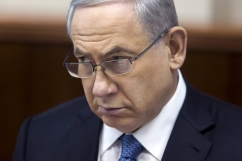
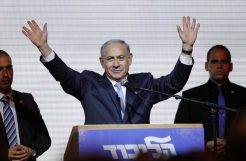
In the recent general election in Israel, Binyamin Netanyahu (popularly known as 'Bibi') won a surprise victory, gaining 30 seats for his right-wing Likud Party against the 24 won by the centre-left Zionist-Union Party. The other surprise of the election was the growth in turnout – though not seats – of the Arab vote, encouraged by their increased solidarity in the so-called 'Joint List' which achieved 14 seats to make it the third largest group in the Knesset. Under the proportional representation system used in Israel, the result of the election is that the leftward-leaning parties achieved 39 seats with potentially another 14 from the Arab group to make 53 votes, while those on the right gained 54 – 30 for Likud and the rest a combination of small right-wing parties. The surprise was that pre-election polls suggested the left was nudging ahead to at least parity and perhaps a slight majority. The remaining 13 seats were won by right-wing religious parties, making certain the return to power of Binyamin Netanyahu. He seems to have achieved this by moving sharply to the right himself. There are several reasons to regard that with deep concern.
Bibi is in the first place a contradiction, sometimes supportive of a 'two-state solution' but more recently rejecting it. The Palestinian issue has been knocked back with a vengeance. Second, Bibi is regarded by senior figures in the Israeli political and military elite as unstable and weak, changing his views too often to please different interest groups. If so, no-one knows what Netanyahu will do next if his position is threatened. Thirdly, Bibi is seen as a religious hypocrite by many Jews. He prays with proper decorum but he mixes with criminals. Who is he? Is he a brave leader who makes a courageous stand for national unity, or is he a vacillator who is blown about by every wind in his path? Some would say he is not nearly as weak as he appears, but rather he is a shrewd operator, a consummate politician who knows how to keep his friends close and his enemies closer. That he is, in fact, a man of principle – but the principle is always to win.
What, then, of his impact on the future of Israeli political life? There are two disturbing trends.
First, Bibi has played the racist card against the Arabs to an unprecedented extent. As news came in of Arabs preparing to vote in larger than usual numbers Netanyahu announced an Arab conspiracy to undermine the election funded by what he termed 'foreign' sources. How citizens entitled to vote can undermine their democracy by actually doing so will probably escape the understanding of people outside Israel, and hopefully inside it as well. Netanyahu has fuelled the flames of anti-Arab racism in Israel. Or to put it another way, he is undermining the legal status of 20 per cent of Israel's citizens by suggesting that their citizenship positively should not count. It really is an extraordinary claim for the leader to make of a supposedly modern democracy.
The second trend is Bibi's encouragement of Israel as a right-wing society. Democracy is anyway under threat from the simple fact that there are now 1.5 million Russians living in the country: people who have never lived in a stable democracy. Some of them ardently desire Israel to be the haven of liberal democracy they never had in Russia. An awful lot of them, though, having little experience of democracy, are happy to see it displaced by a more authoritarian regime, especially if it is stronger above all against non-Jews. What may add to this political sea change is the influence of the religious parties. Various Orthodox and Ultra-orthodox groups argue for a more observant national life, in which other religions will be far more restricted (some would have them banned) and Torah observance will become compulsory, despite the fact that the majority of Israeli Jews are still secular. It could mean the end of a pluralistic and democratic Israel. It might even mean the end of Israel itself if its Muslim neighbours sound the alarm. With their increasingly sophisticated technology, they would pose are far greater threat to Israel than their predecessors in the early decades of Israel's existence as a state.
Two contrary trends should be noted, however. This election has disturbed the political indifference of Israel's Arab community and that may lead to an increasingly sophisticated and informed Arab participation in Israel's political life. Second, the very fact is important that public opinion has become more vocal against the nepotism, corruption and power-hunger of people around Netanyahu, and in support of the allegations made recently by senior figures in Israeli life against Netanyahu himself. It may be that public opinion is not as fixed as the right might hope. Why wasn't that reflected in voting? Because at the moment, the only issue on which Jewish Israelis vote is security, and that seems safer in right-wing rather than left-wing hands.
There has never been a more appropriate time to 'pray for the peace of Jerusalem'.
Phil Hill is pastoral theologian and church theologian at large at Wales Evangelical School of Theology. He was formerly head of ministerial formation at Nazareth Evangelical Theological Seminary in Galilee.