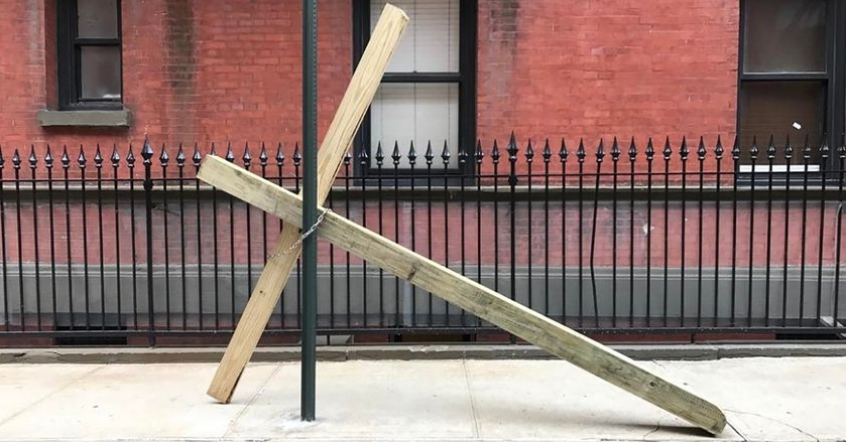
It started with a mysterious act of apparent malice, but it turned into an expression of grace. According to Manhattan resident Micah Latter, Good Friday this year saw the arrival on her street of a huge wooden cross, chained to a lamppost. No-one knew where it had come from, or who had put it there, and more bizarrely still in the days that followed it kept moving around – being fixed to various posts and fences.
This cross was chained to a post in Gay St. Danpire/Instagram
The name of this particular part of New York? Gay Street.
At first Latter was perplexed and upset. As a committed Christian herself, she got the distinct impression that the instrument used to torture and crucify Jesus was being misappropriated to spread hatred (even though the street was actually named in 1833, when 'gay' meant something very different). She told website Popsugar: 'As a Christian, the cross is a sign of love, peace, and hope and it was clear the mysterious owner of the cross was not sharing those same values.'
Then, Latter had an idea. She rallied friends from the neighbourhood, grabbed an eclectic range of paints and some champagne, and embarked on a very creative response to the unheralded and unexplained actions of the unknown cross-mover. In an impromptu act that was part-street party, part-craft session, Latter and her neighbours (and some intrigued passers-by), repainted the cross in the colours of the rainbow, partly to demonstrate inclusivity to the LGBT community, and partly as a demonstration that the cross is fundamentally about grace, not exclusion.
In a final twist, she also added her own locks, and superglued the existing ones, so that the cross could not be moved or removed by its mysterious owner. 'It belongs to the street now,' she said.
Some Christians will no doubt be sniffy about Micah Latter's actions, worrying that the historic and precious symbol of Jesus' death and suffering has been defaced by a political slogan, and one which does not align with the historic orthodox teaching of the Church. But of course, even the original owner was using the cross for a less-than-ethical purpose, and seeking to make it a symbol of hatred couldn't be further from the truth. Once, a long time ago, the cross was a symbol of death, darkness and mis-used power, and Jesus redeemed it. We don't want to go backwards on that one.
More positively, I think that in her act of creative defiance, Ms Latter has disarmed a potentially painful and unhelpful attack, apparently sent from within the church to the heart of the gay community (despite the anomaly around its actual naming, the street is in Greenwich Village, where many of New York's LGBT residents live). In fact, she's now installed a semi-permanent monument to the unconditional, all-inclusive love of God, in a community which might always hear that message shared. The original owner may not agree, but I think it's a wonderfully prophetic act, and one that the rest of the church would do well to learn from.
Martin Saunders is a Contributing Editor for Christian Today and the Deputy CEO of Youthscape. Follow him on Twitter @martinsaunders.
Last week’s elections confirm that people have lost trust in both the system and the politicians - and the fragmentation that exists in British politics.
The Church said it was encouraged by five years in a row of growth while acknowledging that growth, attendance and participation remain below pre-pandemic levels.
Christians in eastern Democratic Republic of Congo (DRC) are facing escalating violence from an Islamic State-linked militant group accused of massacres, abductions and systematic terror attacks across villages and churches, according to a major new Amnesty International report.
Evangelism and discipleship ministry Cru is hoping to mobilise 10,000 churches to spread the gospel during this summer’s World Cup taking place in the US, Canada and Mexico.