As the coronavirus spreads across the world, global leaders are comparing the fight to stop it with a war. Many countries are shutting down their borders, restricting the movement of their citizens, and some supermarkets are even rationing supplies.
But in times of real war, soldiers still laugh and cry at stories of family, friendship, love and loss. And now, as many people find themselves on lockdown and their lives on hold, stories of life and love are a welcome distraction – and often supplied by Netflix.
One that you can find on the streaming service is the South Korean drama 'Crash landing on you'. It's the story of a wealthy South Korean heiress (Se-ri Yoon) who accidentally flies a parachute into North Korea, only to be discovered by a member of the top North Korean elite (Jeong-hyuk Ri). As you might have guessed, the two fall in love – but their love is impossible. Their pain gives the audience a taste of the pain and division experienced by the two Koreas today.
Much of the show takes place in North Korea – but as you watch it, you might be wondering, how much of it is true?
Many North Korean escapees have commented on how North Korea and its people's lives are portrayed in the show quite accurately in many ways:
- The local dialect. You might assume that the language in North Korea and South Korea would be very similar. But after years of isolation from one another, the form of Korean spoken in North Korea has developed separately from the Korean spoken in South Korea – they are quite different.
- The availability of South Korean and Chinese products in the markets. Many products are smuggled into North Korea from neighbouring countries and sold on the black market. This was well portrayed at one point in the show, when a train stops because of a power blackout, and many black-market traders bring out food to sell to those on the train.
- Homeless children on the streets. North Korea has high levels of poverty and malnourishment and limited medical care, so many children are orphaned and left to fend for themselves on the streets of North Korea. I was one of these street children myself.
- The fear of surveillance. The people of North Korea know that they are constantly being watched for any sign of disloyalty or disobedience to the ruling regime. This is why Christians have to be so careful to keep their faith a secret in North Korea. Faith in a god other than the nation's leaders, the Kims, is not allowed, and if a Christian is discovered, they will be arrested, tortured, and sent to a prison camp where they will probably die.
- Watching South Korean dramas. I myself remember secretly watching foreign films with my neighbour's at their house – they had DVDs smuggled from China. It was watching these films that made me realise that life in North Korea was very different from life in other countries.
- The privileged lives of the minority elite. While most of the country struggles with poverty and malnourishment, those who live in Pyongyang live lives of luxury. The richer families like to show off their wealth by adding lace curtains to their windows.
- The kimchi caves. kimchi is a traditional Korean dish of preserved cabbage. Since rural North Korea doesn't get electricity they don't have refrigerators, they have kimchi caves where they store Kimchi, potatoes and other things.
- "... Foreigners or crazy women." Having your hair down is considered a South Korean hairstyle and a sign of capitalism that isn't allowed. The soldier helps her tie it up.
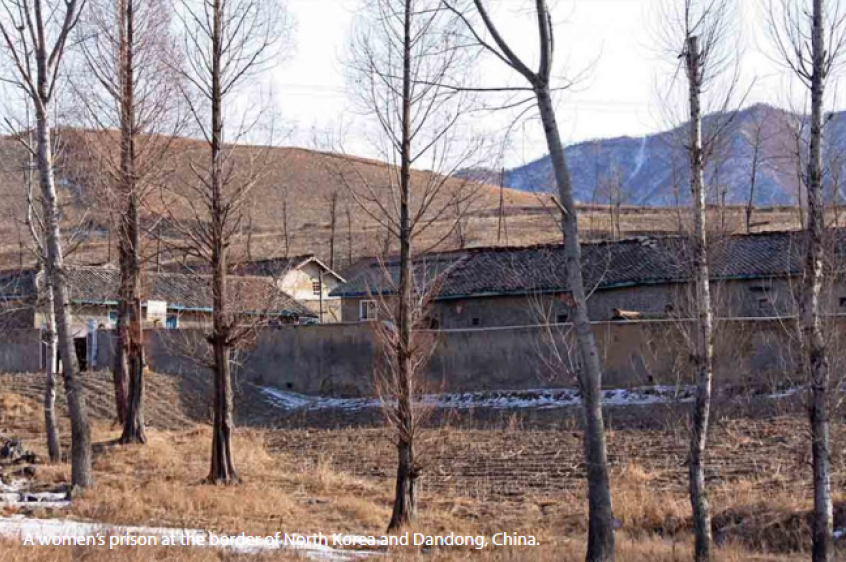
But not everything you see in the show is true – the main one being that the regime is shown to be much less strict than in real life. For example, during a village patrol, a district supervisor discovers a South Korean rice cooker, but she turns a blind eye to it. This would be considered a serious crime in North Korea.
It's still a painful story
The show is more than just a story – it's symbolic of the ongoing division between North and South Korea, the real tragedy of the peninsula. The impossible love between the northerner and the southerner, from different worlds and kept apart by arbitrary forces beyond their control, mirrors the bitter narrative of the two Koreas which has spanned more than 70 years.
It is the Hermit Kingdom's desire to block the fundamental love that is given by our Creator. Instead of loving one another, Pyongyang forces people to close their hearts and distrust each other. The future democratic North Korea will need to experience great reconciliation.
A poignant moment of the show is when the central characters take refuge in an abandoned house in the demilitarised zone which still divides the peninsula. They see a water bowl sitting on top of a traditional Korean storage jar, and the North Koreans explain that this was left out as part of a prayer ritual for a son sent to war, in the hope of a return which never came.
There are too many stories like this of families, brothers, sisters and friends on the peninsula - at least 20 million people have never seen their family members in the other half of Korea. The two Koreas have never formally signed a peace treaty, and they are technically still at war, engaged in a frozen conflict.
Only God's love can melt down the frozen relationships and conflict of North and South Korea, 'with all humility and gentleness, with patience, bearing with one another in love, eager to maintain the unity of the Spirit in the bond of peace.' (Ephesians 4:2-3)
Timothy Cho escaped from North Korea and now works with Open Doors to advocate for human rights.