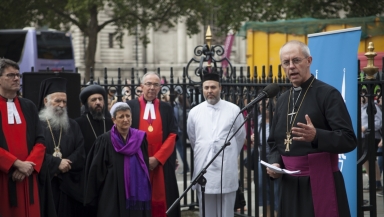
The Archbishop of Canterbury says a "global strategy" is needed to combat the threat of the Islamic State, insisting that "to be effective we must not look for quick fixes".
In an article for Prospect magazine, Archbishop Welby recognises the need for practical action in the Middle East, but said that the use of air strikes alone "is both unlikely to succeed and questionable in its long term effect".
"Military force is inevitably seen as yet more 'crusader' violence and increases support for what it seeks to subvert...All experience of war demonstrates that the longer it lasts the more violent and savage it becomes," he writes.
Welby has repeatedly condemned the "gross violations of the fundamental rights and freedoms" of minority communities in Iraq and Syria.
He has also called for international governments to increase their efforts to support those who are suffering.
"It is extremely important that aid efforts are supported and that those who have been displaced are able to find safety. I believe that, like France, the United Kingdom's doors should be open to refugees, as they have been throughout history," he said in August.
In today's article, he praises the "strong and brave tradition of absolute pacifism" favoured by some Christians, but notes that religious leaders in the Middle East have asked for armed assistance as IS gains momentum.
"They seek temporary support while their own governments get their act together. They do not want the Middle East emptied of its Christian populations, essential to its culture, critical in many areas of life and there since before the time of St Paul," Welby says.
"There is a need to struggle for the values that our own centuries of insane conflict have taught us to treasure. Sometimes this may temporarily include armed force on an international scale."
However, the Archbishop also insists that it is dangerous to consider military action against IS "only as a war of self-defence".
"The justification for our use of military force rests principally in the extreme humanitarian need of the local communities...The aim of our violence must be to prevent the alteration of facts on the ground, and to establish safe space," he says.
"Over-simplification may give us obvious enemies and thus a simpler task, resolvable by force, but it results in mutual destruction."
Any force against jihadists "must be done in the context of a greater and more selfless ideal that renews the vision that rebuilt out own continent" after World Wars One and Two, Welby concludes.
This is a "winnable struggle", he says, "but the victory requires us to reshape our values, as much as to overcome those of ISIS.
"If we respond as we should, if we take this challenge as we should, then the future is a hopeful one for us, and for those areas currently so terribly afflicted."