Last week we saw the Iranian football team standing silent during their national anthem prior to their World Cup game with England in Doha.
This was a hugely brave act, in support of the anti-government protests in Iran, and it could put them in grave danger on returning home.
In their second game against Wales, the Iranian players did sing the anthem – or some of them did, but it looked very much as though they did so under pressure...
Being at risk because of expressing a political opinion is a basis for granting refugee status.
But the Iranian team could not seek refugee protection in the UK (should they want to) unless they had somehow already got themselves onto UK soil, and at present there is no safe and legal route for them to get to the UK.
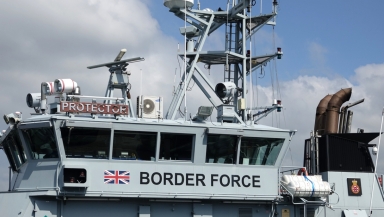
Those players would have no choice but to arrive another way, for example, on a small boat across the Channel. Indeed, Home Secretary Suella Braverman has admitted to the Home Affairs select committee that there is simply no way for most people to seek asylum in the UK outside specific resettlement schemes for Afghanistan, Syria and Ukraine.
But there will always be people who need refugee protection from a range of countries where there is not mass displacement. People who are at risk because of their political opinion, such as in Iran, are among those who would benefit from a functioning asylum system that individuals can access without risking their lives on the sea.
The topic of asylum and immigration is hard to discuss without stirring up high emotions. Human nature is to ally ourselves with those who we think are like us, and to distrust the unfamiliar. I'm sad to say that some in our media and in Parliament fan the flames of these insecurities by using the terms 'illegal' and 'invasion' to encourage suspicion of anyone seeking sanctuary in the UK. The assumption is that people only want to come here to take things from us. In reality, under the refugee convention, it is not actually illegal to enter a country to claim asylum.
More thoughtful commentators ask how we can take in more people when we don't seem able to support our own citizens? This view is supported by the sight of people queuing at food banks, unable to access timely medical treatment or to receive the support that their children need in school. But we should also remember that there are political priorities at work when deciding how to fund our public services, and in reality they have not been adequately resourced over the last decade and are now struggling to cope.
The truth is that people around the world face many trials and persecutions that we are fortunate not to experience in the UK. And our understanding of God's love for all people, made clear in the Bible, offers us a real challenge as we seek to engage with these issues in a Christian way.
I don't believe in a migration free-for-all. There need to be appropriate controls, but I can't support an asylum policy that is driven by a divisive assumption that refugees are aliens seeking to invade our shores. Especially when a hard look at the facts shows that most of the time, 60% of European countries take more refugees per head than we do.
Leviticus 19 reminds us of God's heart of compassion: "When a foreigner resides among you in your land, do not mistreat them. The foreigner residing among you must be treated as your native-born. Love them as yourself, for you were foreigners in Egypt. I am the Lord your God."
Jesus also taught that we should: "Do to others as you would have them do to you."
We are all part of the human family, bearing God's image, regardless of our race, religion or gender, and a compassionate response is something supernatural, ultimately coming from God. Human beings will often seek to preserve and protect their own interests to the exclusion of others, but this should not be the way of those who follow Jesus.
In his book, The Air We Breathe, Glen Scrivener says that God's compassion flows 'down and out' and that it flows to the 'down and outs': "It meets the people in their weakness and then raises them up so they might share the blessings far and wide."
Let's pray for our government and our nation to have a compassionate response to those genuinely seeking asylum on our shores, and for us as Christians to model the love of God by caring for all his people and desiring for them the same freedoms that we ourselves enjoy.
Tim Farron has been the Member of Parliament for Westmorland and Lonsdale since 2005, and served as the Leader of the Liberal Democrat Party from 2015 to 2017.Tim is also the host of Premier's 'A Mucky Business' podcast. His new book A Mucky Business: Why Christians should get involved in politics is published in November.