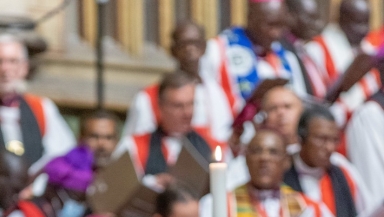
The Archbishop of Canterbury has pleaded with bishops meeting in Canterbury not to "treat each other lightly or carelessly" because of their disagreements over human sexuality.
Archbishop Justin Welby appealed for unity in an address to bishops during a closed meeting to discuss the Lambeth Call on Human Dignity.
The Call has become one of the most contentious aspects of the conference after wording was amended to remove a reaffirmation of Lambeth 1.10, which upholds heterosexual marriage and rejects homosexual practice.
Liberal bishops vowed to challenge the original wording but subsequent revisions have angered conservative bishops who say it should have remained. They have instead issued their own resolution affirming Lambeth 1.10.
At the start of today's discussion, Archbishop Welby said that human dignity and sexuality were "deeply dividing, not only for Anglicans but for every part of God's global church".
"We are deeply divided. That will not end soon. We are called by Christ himself both to truth and unity," he said.
The Archbishop continued by saying that "there is no attempt to change people's minds" within the Call, and that it "states as a fact that the vast majority of Anglicans in the large majority of Provinces and Dioceses do not believe that a change in teaching is right".
"Therefore, it is the case that the whole of Lambeth 1.10 1998 still exists," he said.
"This Call does not in any way question the validity of that resolution.
"The Call states that many Provinces – and I say again, I think we need to acknowledge it's the majority – continue to affirm that same-gender marriage is not permissible.
"The Call also states that other provinces have blessed and welcomed same sex union or marriage, after careful theological reflection and a process of reception.
"In that way, it states the reality of life in the Communion today."
The Archbishop made similar comments in a letter sent to bishops today in which he said he was writing "to affirm that the validity of the resolution passed at the Lambeth Conference 1998, 1:10 is not in doubt and that whole resolution is still in existence".
"Indeed the Call on Human Dignity made clear this is the case, as the resolution is quoted from three times in the paragraph 2.3 of the Call on Human Dignity," he wrote.
"The Call states that many Provinces – and I think we need to acknowledge it's the majority – continue to affirm that same-gender marriage is not permissible. The Call also states that other provinces have blessed and welcomed same sex union/marriage, after careful theological reflection and a process of reception.
"In that way, the Call states the reality of life in the Communion today. There is no mention of sanctions, or exclusion, in 1.10 1998. There is much mention of pastoral care. We have a plurality of views."
His comments today echo his first keynote address at the start of the conference in which he said that disagreements over human identity and sexuality will "not be solved at this conference".
Following today's discussions, specific requests set out in the Call on Human Dignity are to be re-visited at a later session in the conference.