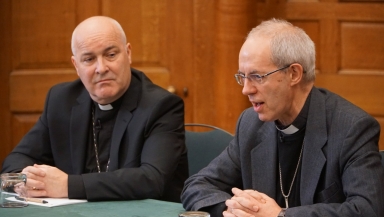
The Archbishop of Canterbury used his Easter Sunday sermon to – amongst other things – declare as 'ungodly' the government's latest announcement that it would deport to Rwanda, refugees who arrived in the UK through irregular routes.
The plan would see the UK subcontract its processing of some refugees to Rwanda, where it is thought their asylum cases could be heard. But the Archbishop said that this approach was 'opposite to the nature of God' and that Christ's resurrection was not the time for us to 'subcontract our responsibilities'.
So how should we think about this? Well, we are to love our neighbour. The famous parable that Jesus told to illustrate this, the good Samaritan, tells us who qualifies as our neighbour. Answer: everybody, especially everybody in need.
That includes people we don't like, people from alien cultures, people we are suspicious of - because that's how the Samaritan would have felt towards the injured Jewish man lying in a ditch. Radical stuff.
Given that most refugees who cross the channel in small boats do turn out to be genuine refugees once they have been processed, many will say it's wrong to deport those people just because of the way they got here. But supporters of the government will respond by saying that the Rwanda plan is about deterring the people traffickers who enable refugees to risk their lives crossing the channel.
I do see that point, but for any refugee who isn't from Syria, Afghanistan or Ukraine, there are almost no safe routes to claim asylum in the UK. And so people from places like Iran, Eritrea and Sudan have no option but to take those risky journeys to get to the UK, if there is no safer option available.
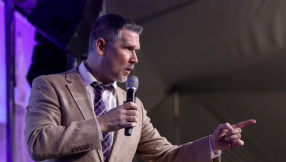
Welby's remarks though drew sincere anger including from my friend, the Christian Conservative journalist and commentator Tim Montgomerie. Tim said, "Christians can legitimately support or oppose the Rwanda policy if – in their souls – their ultimate aim is a safer sustainable refugees policy."
He added, "How dare my archbishop say Anglicans like me are acting against God because we favour a different path to shared goals."
I do have strong sympathy with Tim's reaction here. It is possible for Christians to have different views over a policy like this so long as our motivations are to do good in God's sight.
To put my cards on the table, I strongly disagree with the government's policy partly because I don't think it will solve any problems, but mostly because I doubt the government's motivation. It feels more like a headline to cause a politically helpful culture war row rather than to address a real problem.
Especially when you remember that the UK is not awash with asylum seekers; we don't really have a huge problem to solve; most countries in Europe take more asylum seekers per head of population than we do. To use desperate victims of war and persecution then as pawns in a political game seems unquestionably wrong to me.
So, was the Archbishop out of order to step into politics like this? I don't think so because the Bible tells us that there is good and evil and that we are not to be nice, inoffensive and neutral on such matters. We should be humble and prayerful about speaking into our culture and our politics and do so carefully, fully aware of our own need for forgiveness. But we should surely do so.
The Jesus who overturned the tables of the money lenders in Matthew 21, and who in Mark 7 condemned those who gave to the temple rather than taking care of their elderly parents, was not neutral on the rights and wrongs of the culture in which he lived and walked.
I want church leaders to speak truth to power, to offend and indeed shame those who make bad choices for bad reasons, but I also want Church of England leaders to speak the gospel and I too rarely hear them using their platform to unequivocally do that.
The gospel is far more offensive than anything the Archbishop could have said about refugees - maybe that's why we don't hear it too often. But Christianity is radically counter cultural – it isn't woke and it isn't anti-woke, such considerations are pathetically puny in comparison.
Instead it claims to be the ultimate truth. It tells us that we are not our own, that we will face God's judgement. It crushes our egos telling us that we all need forgiving. It denies us vengeance by telling us to forgive.
It tells us that Jesus, not politics, is our only hope. It tells us that all have sinned and fallen short of the glory of God, that the wages of sin is death, but that the gift of God is eternal life through Christ Jesus.
I think on balance the Archbishop was right in his remarks, but I'd love it if church leaders chose to be truly offensive and preach the gospel.
Tim Farron has been the Member of Parliament for Westmorland and Lonsdale since 2005, and served as the Leader of the Liberal Democrat Party from 2015 to 2017. Tim is also the host of Premier's 'A Mucky Business' podcast, which unpacks the murky world of politics and encourages believers around the UK to engage prayerfully. Season 3 starts January 2022, you can listen on your chosen podcast provider.