I am Rev Jonathan Herbert a Church of England vicar who works as chaplain to Gypsies and Travellers in Dorset and Wiltshire, and I live at Hilfield Friary, a Franciscan community dedicated to a life of prayer and care for our environment.
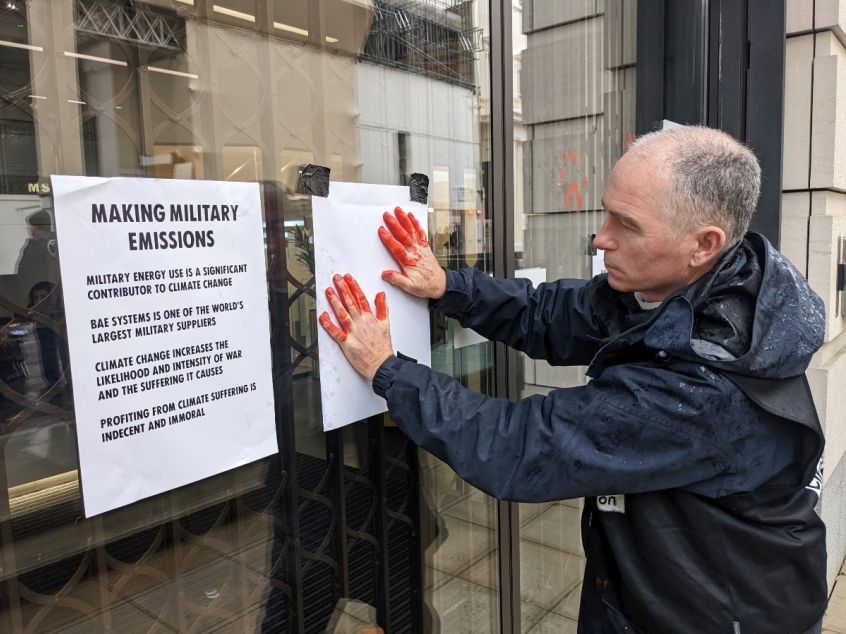
This week I took a stand outside BAE Systems' headquarters in London, Europe's biggest military supplier and the seventh biggest in the world.
When people protest against weapons manufacturers, it is often due to the direct death and destruction their weapons cause. What is less well known is that the manufacture, testing and use of armaments cause climate change. It is estimated that the world's militaries combined, and the industries that provide their equipment, create around 6 per cent of all global emissions.
There were four vicars in total protesting the arms company this week, all wearing our dog collars. Alongside us there were around 10 other Christians, all members of Christian Climate Action. They were holding a banner reading 'BAE Systems fuels climate suffering'. It was a sombre protest. We dipped our hands in red paint to represent the blood of those who have been lost through the death and destruction BAE Systems creates.
We spent time during the protest praying together and singing. This was important to me because protesting against climate change can appear hopeless given our government's inaction and its close ties to oil companies and arms manufacturers like BAE Systems.
The protests took place in the wake of the global climate summit, COP27, where countries refused to agree on the phase-out of all fossil fuels, let alone what we need – no new fossil fuel extraction or expansion. It is easy to feel small when standing up against such powerful and oppressive companies. However, in God all things are possible and in prayerful protest I hand the power over to Him.
This week's protest was part of a wider day of action. The theme was 'Cut the ties' – a call on all companies and industries, both public and private, to cut their ties with fossil fuels. This is what needs to happen if we stand any chance of tackling climate breakdown.
There were 12 other organisations targeted: BP, Hill+Knowlton Strategies, Church House, Ineos, Eversheds Sutherland, JP Morgan Chase, Schlumberger, the International Maritime Organisation, The Institute of Economic Affairs, Arch Insurance, the Ontario Teachers Pension Plan and the Department of Business, Energy and Industrial Strategy.
As a Christian I took part in this action because, in a time of climate emergency I believe this is what being faithful looks like. The UK military's total annual carbon footprint is estimated to be around 11 million tonnes, which is roughly the amount six million cars would emit annually. We can each try our best to reduce, reuse and recycle, but if we don't get our military emissions, like those produced in arms manufacturing, under control, we're not going to see the change we need.
It's also easy to see that the arms industry and the oil industry are interwoven in the suffering they bring. A vicious spiral has been created where the military is a driver of climate change and in turn climate change increases the likelihood and intensity of war. Add to this that defending fossil fuel reserves has been a driver of wars around the world and you have a recipe for disaster.
Following a God of justice means that we need to see the plight of those suffering as our own plight. Like the prophets in the Bible, we need to speak out against and unmask evil and injustice. This week was my attempt at putting that principle into practice.
Rev Jonathan Herbert is a member of Christian Climate Action