Catholics around the world were agog to hear what Pope Francis had to say in his exhortation on the family, Amoris Laetitia (The Joy of Love). Would he relax the Church's teaching on abortion or divorce? In the end, he didn't – but research from the US shows that there, at least, Catholics wouldn't have cared much either way.
Figures from the respected Pew Research polling organisation indicate that in spite of his popularity, only about one in 10 American Catholics say they turn to the Pope "a great deal" for guidance on difficult moral questions.
Most Catholics say they look inward for guidance, with roughly three-quarters of US Catholics (73 per cent) saying they rely "a great deal" on their own conscience when facing difficult moral problems.
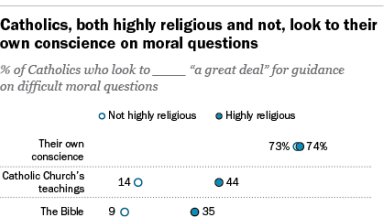
Only 21 per cent look to the Catholic Church's teachings, while 15 per cent turn to the Bible and only 11 per cent say they rely a great deal on the Pope.
However, Catholics who are highly religious – defined as praying daily and attending services at least once a week – are considerably more likely than other Catholics to seek guidance from Church teachings, the Bible and the Pope. Still, no more than half of these highly religious Catholics give great weight to any of these sources of guidance, while 74 per cent say they rely a great deal on their conscience.
The Pew survey also points out, however, that relying on conscience to make moral decisions doesn't conflict with the Church's teaching. It cites the Church's Catechism, which says that "a well-formed conscience is upright and truthful" and that the "education of the conscience is a lifelong task".
In this light, a person's moral decisions are guided by a conscience formed by engaging with the Bible and the Church's teachings – among which are the pronouncements of the Pope.
However, the survey does raise questions about what Catholics would do if advice from the Church or religious leaders conflicts with advice from family or other sources. More than eight in 10 US Catholics say they depend "a lot" on their own research in the decision-making process. Advice from family was the second most popular choice among Catholics, with half saying they rely a lot on relatives.
Though the Pew report does not refer to this, one of the pressure points for Catholics in making moral decisions is the use of artificial contraception. The Church is officially opposed to it, but most Catholic women use it.