The Christian doctrine of the Holy Trinity is a paradox that has puzzled believers for millennia. Many point to majestic, ineffable mystery, but has the divine enigma of the Trinity been solved by a children's toy?
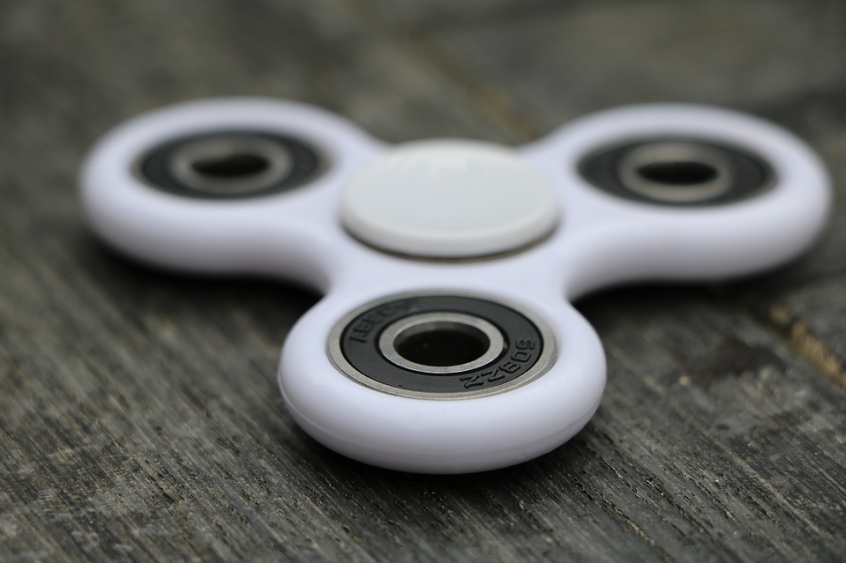
Fidget spinners are the simple toy designed to relieve stress and comfort the distracted. Their spinning mechanism (which takes different forms, but a triune structure is the most common) requires the user hold the centre while the surrounding bearings spin. Describing it is a little superfluous – it takes about two seconds to understand what a Fidget Spinner is when you've seen it in action.
The low-tech device has surged in popularity in recent months, amongst both schoolchildren and working adults struggling with the daily grind. It's perhaps refreshing to see that in an entertained world abundant with complex gadgetry, we're still awed by simplicity.
As last week saw Trinity Sunday celebrated across the Church, many found themselves wondering – does this spinning contraption point us to God?
Its tripartite design does resemble certain images of the Trinity. And while objects like three-leaf clovers have been touted in the past as analogies for Gods triune nature, the Fidget Spinner goes further because it spins – and so perhaps better captures the dynamic movement, equality and relationality of the Godhead. After all, it's been popular to describe the mutual indwelling of the persons of the Trinity – the perichoresis (Latin for 'rotation')– as a 'divine dance'.
The danger is of course, that when you try to talk about God, you soon end up being a heretic. A popular video by Lutheran Satire shows Irish icon St Patrick schooled by local peasants for his heretical rendering of the Trinity as a shamrock. The shamrock implies 'partialism', the idea that the Father, Son and Holy Spirit each make up one third of the wholeness of God. Orthodoxy would say that each person of the Trinity is wholly God, not a segment of God.
Patrick is also chastised for suggesting God is like water/vapour/ice, since by doing so he confesses 'modalism' (also known as 'Sabellianism') wherein each member of the Godhead is just the one person appearing in different forms. Orthodoxy rather says that God is three distinct persons, not just three 'versions' of the one.
It looks like the Fidget Spinner takes us into the direction of partialism, though its creators probably shouldn't be excommunicated for the fact. Theologian Steve Holmes posted wryly online:
There's something a little cheesy about Christians always pointing to culture's latest fad, seizing the opportunity to declare that 'God is just like that!' Then again, Christian theology would also say its basic to humanity to seek God out and ponder his mystery, looking for connections in creation.
Perhaps Fidget Spinners, like any good analogy, can point us to God – whilst also pointing at their own inadequacy.
Schoolchildren and office-workers might not be provoked to ponder divine transcendence as they spin their way through the day – but you never know.
The doctrine of the Trinity speaks of the most majestic of realities being brought to bear on the most mundane minutiae of life. Perhaps a simple yet mesmerising, now ubiquitous little toy captures that quite nicely.
You can follow @JosephHartropp on Twitter