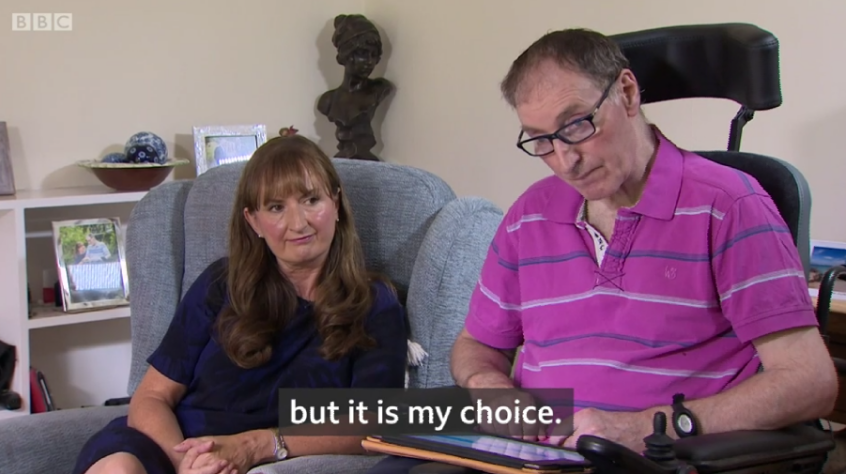
After the death of British man Richard Selley at the Dignitas clinic in Switzerland, Dr Gordon Macdonald of anti-euthanasia campaign group Care Not Killing explains why he thinks the UK's laws on assisted dying should not be changed.
We are sorry to hear about Mr Selley's death. It is sad also that the death of Mr Selley is being used to try and justify a campaign that will rip up long held universal protections, by treating those who are terminally ill, disabled, or have chronic conditions differently in law. Such a change in the law will put vulnerable people at risk of abuse and of coming under pressure to end their lives prematurely.
Parliamentarians across the UK have repeatedly rejected attempts to introduce assisted suicide and euthanasia, more than ten times since 2003 out of concern for public safety, including in 2015 when the Scottish Parliament overwhelmingly voted against any change in the law by 82 votes to 36 and the House of Commons by 330 votes to 118.
They did this because they recognised the erosion of so-called safeguards in the tiny number of places that have changed the law to allow assisted suicide and euthanasia - countries like Belgium, the Netherlands and the American states of Oregon and Washington.
In Oregon, which is often cited as a model by those championing a changing the law to allow assisted suicide, a majority of those ending their lives do so because they fear being a burden on their families or carers. At the same time because of health care rationing we have seen those suffering from diseases including cancer refused potentially life-saving and life extending treatments, while being offered the poison to kill themselves.
In Canada, which only changed the law in 2016, improvements to palliative medicine have not materialised, their so-called safeguards have been weakened and some patients have been denied medical and social care but offered the drugs to take their own lives.
In the Netherlands and Belgium, which both allow euthanasia, laws have been extended from mentally competent terminally ill adults to non-mentally competent adults and even children. Most recently this was highlighted in Belgium by the case of Godelieva De Troyer(64). She was physically healthy, but had a long and well-documented history of mental health problems. In 2012 she was euthanised by the Belgium State without consulting either her son or the psychiatrist who had cared for her for more than 20 years. That death is now being considered by the European Court of Human Rights after a complaint by her son.
In the Netherlands, there was a case of a 74-year-old who was suffering from Dementia who was killed in 2016. The doctor allegedly failed to verify that the woman wanted to end her life, sedated the woman and asked her family to hold her down as she administered the lethal drug. That doctor is now facing prosecution by the Dutch authorities. Both these cases show how assisted dying laws are operating way beyond their original intent and how patients who are not mentally competent are being killed.
This is why not a single doctors group or major disability rights organisation supports changing the law, including the British Medical Association, the Royal College of General Practitioners, the Royal College of Physicians, the British Geriatric Society and the Association for Palliative Medicine.
Dr Gordon Macdonald is Chief Executive of Care Not Killing, an alliance of individuals and organisations campaigning against the legalisation of assisted suicide and euthanasia, and improved palliative care.