Parting is such sweet sorrow. This week I closed the door and turned the key for the last time in the house that has been our home for 27 years. Saying farewell to the place you have lived, and the church and city you have served and loved is indeed a bitter/sweet experience.
I am a 'somewhere' person not an 'anywhere person'. I need a home, a physical place to be, a community to belong to. I cannot live in an ethereal space or with some vague notion of being a citizen of the world. Rather than visit 21 countries in 21 days I want to be able to walk and pray every street in my town or city neighbourhood.
My wife and I are leaving for positive reasons, to take up the challenge of spreading the Gospel in another city on the other side of the world – Sydney. But although the reasons are positive and I am certain it is something that the Lord has led us to, nonetheless it is a hard and somewhat sorrowful experience – tearing up roots carefully laid down over decades.
Leaving the home where you raised your children, fed your friends and always returned to. Leaving family, friends, church and country – it ain't easy. The strangeness of living out of a suitcase, of not having any keys and of knowing that you are not returning 'home'.
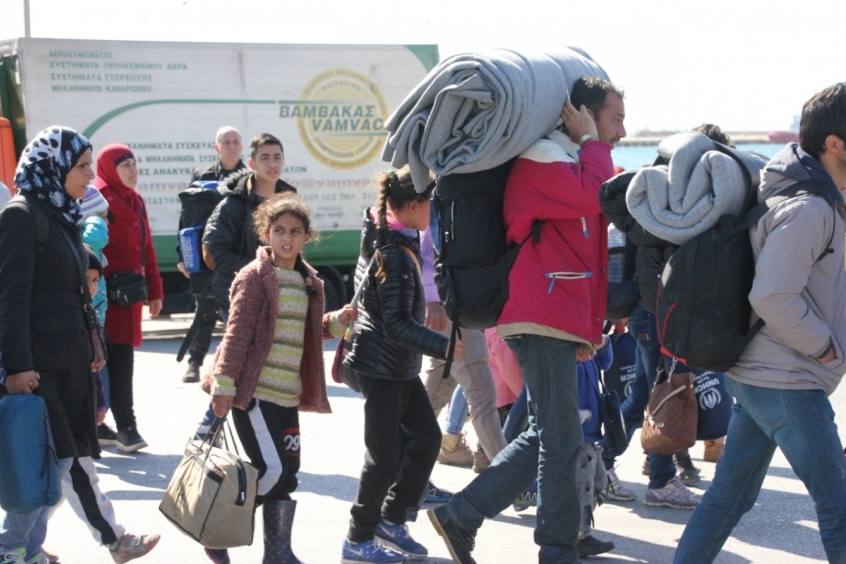
But our experience pales into insignificance compared to those who have to do the same thing for much harder reasons. This week two such people, Oscar Alberto Martinez Ramirez and his 23-month-old daughter, Valeria, came to the world's attention. They drowned crossing the Rio Grande from Mexico into the US. A photo of their bodies has gone viral and reignited the complex and difficult debate around illegal immigration.

What makes a man tie his daughter under his shirt and try to swim a river in order to get to another country? He must have known the risks. Why leave home and the familiar to make a hazardous and dangerous journey to a destination about which there are many unknowns and fears.
I think it is quite simple. The fear of what lies behind overcomes the fear of what lies ahead. Many who come from South America are fleeing the gangs and lawlessness that destroy so many communities. Others are 'economic' refugees.
It's easy for well-off people to decry this but surely we can understand why someone would want to provide their family with a better life?
Mr Martinez was from El Salvador. He worked in Papa John's where he earned around $10 per day. The family lived in Altavista, a large housing complex consisting of small concrete houses. It is a community dominated by gangs, but Mr Martinez's mother says he was not fleeing violence, so much as poverty. He had bought into the American dream and wanted it to become a reality.
It is a sad and unspeakable tragedy that he and his daughter died in this way. What can be done about these situations? I don't know. An open borders policy would not work – because no country could survive if millions of people suddenly entered it. A closed borders policy does not solve matters either – and indeed may make these kind of tragedies more likely.
As we reflect and pray about this as Christians perhaps there are things that we can do. If we are biblical Christians we must use the Bible to interpret our culture, not use our culture to interpret the Bible.
Do not oppress a foreigner; you yourselves know how it feels to be foreigners, because you were foreigners in Egypt. (Exodus 23:9)
I was a stranger and you invited me in. (Matthew 25:35)
We should do what we can to welcome the stranger. We should spend ourselves on behalf of the poor and seek justice in all countries. And we should point all people to Christ.
Because as Christians we recognise that in a sense we are all strangers here. This world is not our home – we're just a passing through. Ultimately all of us are uprooted. We are on a journey to an eternal destination. When we become Christians and have the sure and certain hope of Heaven, that does not mean we become rootless in this world, it means that we can deepen our stakes and broaden our tent cords (to use the image of Isaiah) – so that we can love deeply and share widely – knowing that ultimately our final destination is secure and happy.
Tom Petty and the Heartbreakers sang in 'Living like a Refugee': "Everybody's had to fight to be free, you don't have to live like a refugee."
That 'right' and freedom only comes through Christ. Let us live like those who have a home...and let us invite the homeless and rootless to find their home and root in Christ.
David Robertson is a minister in the Free Church of Scotland. He blogs at www.theweeflea.com