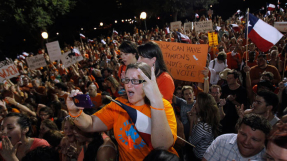
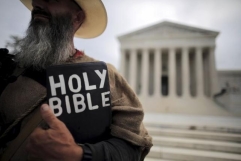
The battle over abortion restrictions in Texas has reached the US Supreme Court with a women's coalition asking the justices to rescind a law passed in 2013 that, it says, will force the closure of more than 75 percent of the abortion clinics in the state once fully implemented.
The Supreme Court is expected to tackle not only this abortion issue but also a similar one in Mississippi, which is also pending in the court, when it begins its new term next month.
According to the Center for Reproductive Rights, the law in Texas "would cause profound and irreparable harm to the rights, health, and dignity of women throughout the state, the second most populous state in the nation," reported NBC News.
The coalition is asking the Supreme Court to review a June 2015 decision of the US Fifth District Court of Appeals, which upheld a law that would require abortion providers to obtain local hospital admitting privileges and for abortion clinics to meet standards like an ambulatory surgical centre.
The centre noted that the US Supreme Court has blocked the enforcement of the law twice—in October 2014 and just last June.
It said without the intervention of the Supreme Court, only 10 clinics out of the 41 in the state will remain open.
"Texas politicians are trying to sneak around the Constitution and more than four decades of Supreme Court precedent with sham laws that do nothing to improve women's health care. This Court has the power to stop the sham," said Nancy Northup, president and CEO of the Center for Reproductive Rights.
The centre said since Roe v. Wade was decided in 1973, the US Supreme Court has continually maintained women have a constitutional right to decide whether to end or continue a pregnancy—protected by the 14th Amendment right to liberty.
It will take months before the Supreme Court can decide if it will hear the case.
"An abortion facility will remain open in each area where an abortion facility will close," the state contended, meaning that women in Texas "will not have to travel any materially greater distances to obtain an abortion."
A lower court declared the law invalid but a federal appeals court upheld it for the most part.
The Supreme Court has previously ruled that abortion restrictions cannot impose "an undue burden" on a woman's access to the procedure.
In its decision, the appeals court said "undue burden" standard does not permit judges to strike down abortion restrictions by finding that they do not further a valid state interest. It said a restriction must be upheld if "any conceivable rationale exists" for imposing it.
"These restrictions have nothing to do with protecting women and everything to do with closing down clinics and pushing abortion out of reach," said Amy Hagstrom Miller of Whole Women's Health, one of the groups urging the Supreme Court to take up the Texas case.