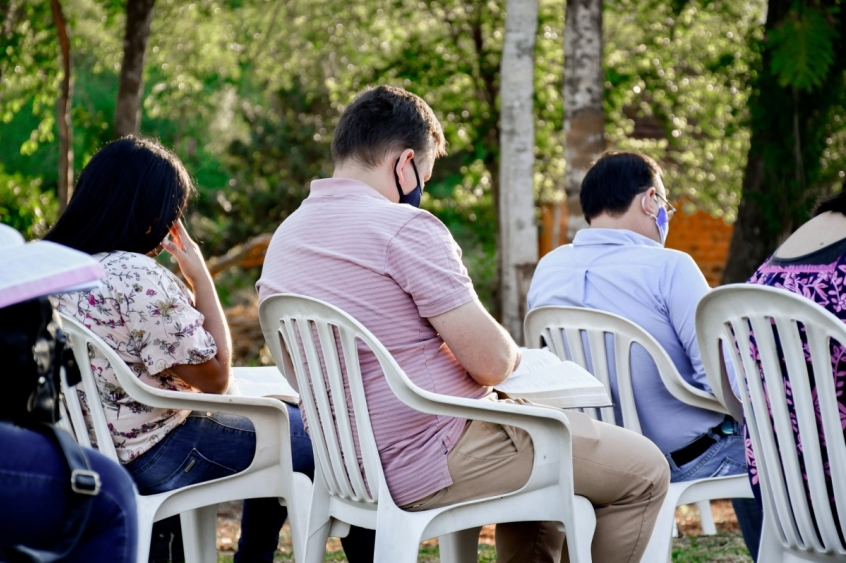
(RNS) Across the country, religious congregations have reopened, or reopened with some health restrictions still in place, after two long pandemic years, according to a new Pew Research survey.
But there has been little or no rise in the number of people attending in-person religious services over the past six months, while the number of those watching services online has also remained steady.
The survey of 10,441 U.S. adults taken March 7-13 showed that only 27% of respondents said they attended services in person this month (compared to 67% who typically do). Back in September, when the coronavirus was still surging and hospitals were reaching capacity numbers, the percentage of those attending in-person religious services was 26%.
Likewise, those streaming services online remained steady: 28% in September 2021 and 30% today.
Pew researchers suggested the plateau in in-person religious service attendance could rise if the pandemic continues to recede, or drop if a new coronavirus variant emerges.
Watching services online will likely continue to be higher, they said, than it was before the coronavirus outbreak began in early 2020.
Religious scholars are now beginning to field studies to determine the long-term impacts of the coronavirus on religious service attendance.
Scott Thumma, a sociologist who recently began a five-year study of how congregations have fared during the pandemic, said his initial findings show a modest increase in in-person attendance from last summer to November. (The project relies on data from religious congregations rather than individual attenders.)
"We're not going to know the full impact for quite a few years," said Thumma, who directs the Hartford Institute for Religion Research. "People are still hesitant to go back. Clergy are still struggling with convincing people to come back. A lot of people are either content to not go or rely on online services."
In the Pew survey, 21% of adults who said they attend religious services monthly said they have not gone back to in-person services and attend online only.
Only 5% of respondents said their places of worship were still closed. Respondents across all categories reported a rise in the number of congregations holding services as they did before the pandemic.
Black Protestant churchgoers stood out as the Christian group most likely to have watched religious services online or on TV in the last month. This group with deep religious commitments was more likely than evangelicals and mainline Protestants to say they watched online services in the last month, in keeping with other studies that suggest Black churchgoers are far more cautious in protecting themselves from the virus.
The survey did not contain enough respondents from non-Christian faiths to report their worship habits separately.
The survey also showed that the share of Republicans and Republican-leaning independents who said their churches were open as before the pandemic was roughly double the share of Democratic congregants who said the same (58% vs. 27%).