Today is St Andrew's day, both a national celebration for the Scots regarding their patron saint, but also a key Christian feast day – highlighting a crucial figure from Scripture, but one easily forgotten.
The Gospel stories relate that Andrew was the brother of Simon, who became Peter – the 'rock' of the Church. But without Andrew, we might never have heard Peter's infamous story. While 'the rock' makes for a fascinating character study in flawed individuals redeemed by God, perhaps more need to hear today the lessons not of high-profile Peter, but his overshadowed brother.
While a rich cult surrounds the legend of St Andrew, the Bible really says little about his life, except that he was one of Jesus' 12 disciples, following the earthly Christ until his ancension to heaven. In John's Gospel, Andrew is a disciple of John the Baptist. When the Baptist declares, seeing Christ: 'Look the Lamb of God!', Andrew and another disciple immediately follow Jesus:
'Turning around, Jesus saw them following and asked, "What do you want?"
They said, "Rabbi (which means "Teacher", "where are you staying?"
"Come," he replied, "and you will see"' (John 12:38-39).
The first thing Andrew does is tell Peter: 'We have found the Messiah.'
Matthew and Mark's Gospels tell slightly different stories, in which the fishermen Andrew and Peter are both together when Jesus comes their way, calling them: 'Come, follow me, and I will send you out to fish for people'. Both men drop their nets 'at once' and follow Christ (Matthew 4:18-22; Mark 1:16-20).
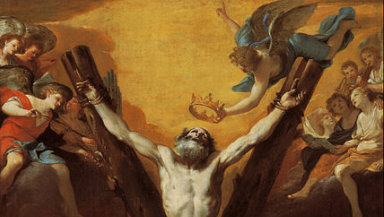
However we account for the narrative differences, a common thread remains: Andrew is just a humble man, invited to follow Jesus. He shows no hesitancy, literally or figuratively 'dropping his net' to follow this Messiah. He quietly reappears in other Gospel stories, but never reaches the prominence of his famous and fiery, Christ-denying and Church-founding brother. Legend tells that he ended his life crucified as a martyr, bound to an 'x' shaped cross or 'saltire'. It's said that like his brother (Peter was supposedly crucified upside down), Andrew refused to be killed in the same way as Christ.
Contemporary Christian celebrity culture seems to know many like Peter: outspoken, charismatic leaders who make public failures and perhaps also public recoveries. We might even aspire to such colourful tales, wishing our testimony had such theatre. We talk endlessly about raising up 'leaders', but seem less excited about a culture of 'followers', even though that's what Jesus talked most about. Perhaps under the guise of seeking 'influence', fame takes priority over faithfulness.
Andrew is not an impressive disciple, in the sense that his story lingers with us. In contemporary terms, he had no 'platform' and did not decisively shape any events. All we know is that he followed. He could have betrayed like both Judas and Peter, but instead was quietly steadfast. As he learned from Jesus, true glory was to be found not through self-exaltation but self-humiliation. The cost of discipleship meant going down before you were lifted up. Carrying a cross, not a crown of celebrity. Dying to self, not living for it.
The vision is not masochistic self-flagellation but a purposeful discernment of what matters most, and how true life might be found. Because if you lose your life for God's sake, Jesus said, then you can truly find it.
Andrew might have laughed at the global cult following that emerged millennia after his death. It surely wasn't something he was invested in. He might have cried at the way some believers today prize fame over simply following, desiring to be known by others more than they know God – and obstructing one truly worthy of praise.
Maybe this saint's draw was simple: he displayed no titanic faith or mighty miracles – rather he was just like one of us. In the words of Loretta Lynn, 'Everybody wants to go to heaven, but nobody wants to die'. But as Andrew shows us – anyone can die, and that means anyone can live.
In an age of competitive comparison and toxic celebrity – especially in the Church – the levelling and illuminating tale of Andrew is a mercy to remember.
You can follow @JosephHartropp on Twitter