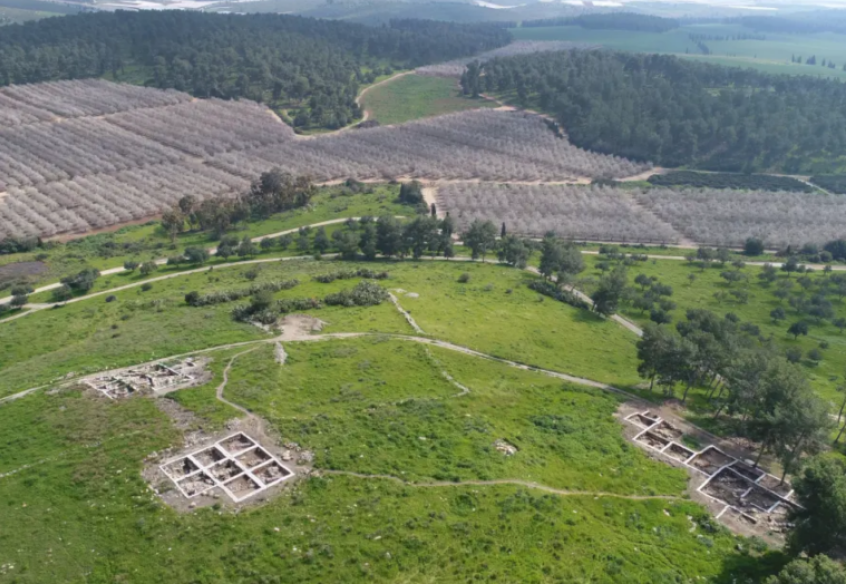
Some weeks ago biblical archaeologists claimed that they had found biblical Ziklag, the town which features prominently in 1 Samuel 29 and 30. Immediately many of their colleagues raised their voices in doubt, and no new arguments have been brought forward since. Time to take stock.
What was discovered in this dig – which began in 2015 – is of considerable importance. At Khirbet a-Ra'i, near the modern-day Israeli city of Kiryat Gat, Yosef Garfinkel and his team found a small town which had first been inhabited by the Philistines, then destroyed, and subsequently occupied by Israelites in the tenth century BC, that is, the period of David and Solomon.
They uncovered quite a bit of Philistine material and even more Israelite vessels, storage jars, stone and metal tools, bowls and oil lamps. The researchers at Khirbet a-Ra'i say it is the first site to contain evidence both of a Philistine settlement and of a settlement from the era of King David, leading them to conclude that it is biblical Ziklag.
So why is it that not everyone is convinced this town is indeed Ziklag? After all, no one disputes the date of the original Philistine and Israelite settlements. The latter fits well in the era of David and Solomon.
First of all, for the simple reason that the actual name was not found. That's normal in archaeology; names of locations are hardly ever found, but it does mean that all we have are mute stones. Second, over time a dozen other sites have also been identified as Ziklag. This new site is not automatically the real Ziklag just because someone claims so.
Third, the lead archaeologist in the excavations, Garfinkel, has in the past made some dubious claims about other discoveries. This time he did not even consult colleagues before going to the press, as is good practice among scholars.
A rumour on the internet has it that even helpers digging on the site were not told about his claim that what they were working on is Ziklag. His opponents have accused him of simply being after more funding. Whatever the truth of these claims, they throw more doubt on the claim that it is indeed Ziklag.
Fourth, unlike what Garfinkel suggests, experts point out that there are similar sites where a Philistine layer is followed by an Israelite layer; and this is what 2 Samuel 8:1, 1 Kings 4:21 and 1 Chronicles 18:1 lead us to expect. The site at Khirbet a-Ra'i is not unique, just one of several.
Finally and decisively, Khirbet a-Ra'i (coordinates 31°35'26.83"N, 34°49'10.03"E) is in the wrong place. It is in the heart of Judea, pretty close to the main cities of Jerusalem and Lachish. This location does not match the fact that the Bible emphatically says that Ziklag was in the Negev region in the south of the kingdom of Judah.
Ziklag was given to the tribe of Simeon which settled in the southern part of the territory of the tribe of Judah (Joshua 19:5). Its location is detailed even more clearly in Joshua 15:20-32, where verse 21 speaks about the 'southernmost towns' and verse 31 mentions Ziklag. Biblical Ziklag was not at all close to Jerusalem, as Khirbet a-Ra'i is.
Can we identify Khirbet a-Ra'i with any other biblical location? Not at the moment, and we may never be able to. Yet that does not make it any less valuable as a source of objects from biblical times.
Rev Dr Pieter J. Lalleman teaches the Bible at Spurgeon's College; for his recent books see here