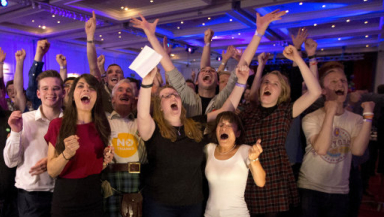
It was a closely fought campaign to the end but on the night, Scots affirmed their desire to remain within the UK by a consistent margin.
Key areas like Glasgow and Dundee voted Yes as they had been expected to, but the victories were not substantial enough to turn back the tide of No votes across the 32 council areas. Edinburgh was a hefty 61 per cent against independence, a predicted No vote.
There were some surprises for both sides, with historically pro-SNP areas like Perth and Kinross voting No.
The turnout was consistently high, on average 85 per cent across the 32 local authorities. In the end, 45 per cent of Scots (1.6 million) voted Yes and 55 per cent (2 million) voted No.
Scotland's First Minister Alex Salmond was greeted with rousing applause by Yes supporters as he took to the podium to deliver his first speech following defeat.
An emotional Salmond said British politics "won't be allowed to go back to business as usual" after a significant 1.5 million Scots voted in favour of independence.
He reminded UK party leaders of their promise to devolve more powers to Scotland, saying, "Scotland will expect these to be honoured in rapid course."
"I pledge to work constructively in the interests of Scotland and the rest of the United Kingdom," he said.
As it became apparent in the early hours of Friday morning that the vote was heading towards a No, Nicola Sturgeon had admitted to feeling "deeply disappointed" but also "exhilarated" by the referendum campaign and the high level of engagement by the Scottish people.
"The status quo hasn't got any kind of endorsement tonight," she told the BBC.
"People should not lose a sense of what has happened in Scotland over the last few weeks ... We need to pick ourselves up and move on. That appetite for change is there, that demand for change is there, and it is our responsibility to make sure that demand is met."
The focus has quickly shifted to the response from the UK party leaders and their pledge to give more powers to Scotland. Income tax, VAT and benefits are some of the areas that could be affected by further devolution.
Although Scotland has decided to stay, huge changes are set to come in across the UK as a result of the historic vote, with questions abounding about changes at Westminster and the decentralisation of powers across other regions, taking the UK towards a federal model.
As the conversations - and negotiations - over the future of Scotland and the rest of the UK begin in earnest, churches are focusing on reconciliation after months of intensive and often heated campaigning.
Speaking on behalf of the College of Bishops of the Scottish Episcopal Church, the Primus, the Most Rev David Chillingworth, said: "The people of Scotland have decided that Scotland will continue to be part of the grouping of nations which make up the United Kingdom.
"The Scottish Episcopal Church is an historic Scottish Church. Our story is interwoven with the story of Scotland. We commit ourselves to work with all the people of Scotland as our relationships with our neighbours continue to evolve.
"We hold particularly in our hearts and in our prayers today those for whom this decision brings a feeling of hopes dashed and vision lost. With our partner churches and all in the faith communities, we pledge ourselves to work for reconciliation and pray for healing in our community."
Fred Drummond, national director of the Evangelical Alliance Scotland appealed to Scots "to unite as a nation and build a new and better Scotland based on the vision, hope and aspiration which characterised the debate".
"As Scots now consider what kind of nation will now emerge from this campaign, the church must lead – and be allowed to lead - the way to ensure the new Scotland is one that reflects God's values in the economy, the family, our communities and our environment," he said.
He also recognised that while many Scots would be celebrating the result, there would also be a significant number feeling devastated.
After months of campaigning that became increasingly fraught in the final weeks, Mr Drummond said now was the time "to show grace and kindness to those on the other side and move quickly to bring reconciliation where it is needed in our land".
"I know it will be a difficult thing for some people to do but we must love our neighbour. We are all Scots and Scots at heart together. If we put God's love at the heart of what we do, healing will be much faster, genuine and long-lasting.
Christian values have built Scotland and helped it to achieve the success in society. Let's reinforce these principles and strengthen them. It is an undeniable fact that Christian values have been good for our society."
He concluded with an appeal to Christians in Scotland, England, Northern Ireland and Wales to come together in prayer.
"Scotland and the UK will not be the same after this vote. We the Evangelical Alliance and our member churches stand ready to play our part," he said.