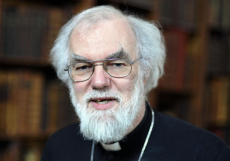
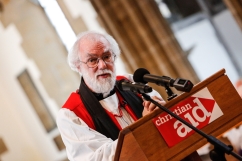
The former Archbishop of Canterbury, Rowan Williams, has admitted he has "no problem" with legal parity for same-sex couples.
But he feels the State rushed into "redefining" marriage without giving the Church enough time to think about it.
The revelations come in the latest edition of his biography, Rowan's Rule, by Rupert Shortt, which is published next month.
When appointed Archbishop of Canterbury in December 2002, succeeding evangelical Lord Carey of Clifton, many who were familiar with his theology and his position as patron of Affirming Catholicism believed he would take the Church in a liberal direction. They were disappointed when, the following year, he pressured Dr Jeffrey John, an openly-gay clergyman in a long-term but celibate relationship with another priest, to withdraw from his controversial nomination as Bishop of Reading.
Shortt describes how the Archbishop, now Baron Williams of Oystermouth, was tackled by a disappointed friend at the Hay Festival.
He writes: "A venerable Roman Catholic priest and scholar confronted Rowan after the ceremony for 'letting us down', by which he meant gay and pro-gay Catholics hoping for a lead from the Anglicans. Rowan clasped his head in his hands – a characteristic gesture – in apparent acknowledgement that his questioner (also an old friend) had a point."
Shortt asked him about the Church's present stance. The Archbishop replied: "Let me just say that I think the present situation doesn't look very sustainable."
On gay marriage, he said: "I have no problem with legal parity for same-sex couples. But I'm not sure it's an appropriate use of the state's power to change a social institution. It felt as though we were being bundled into redefining a word without sufficient time to reflect."
On the failure of General Synod to pass the legislation on women bishops, Shortt writes: "Rowan fell into a pit of depression on returning to Lambeth, during which he hardly spoke to anyone but [his wife] Jane – invariably a model of calm as well as charm."
On the battles in the worldwide Anglican Communion over sexuality, Shortt writes: "The associated emotional toll he suffered is not easily overstated. Eight years previously [in 2005] he had slumped against a doorway during a bishops' meeting and said to a colleague, 'I can't tell you how much I hate this job.'
"At around the same time, a leading churchman found himself in a taxi with Jane Williams on their way to a speaking engagement. 'Can I check that Rowan knows he's the only person who can be Archbishop of Canterbury right now?' he asked. 'I know,' Jane replied. 'But that doesn't make it any easier.'"
One of the Archbishop's abiding concerns was the fate of Christians in the Middle East where communities have existed since New Testament times. The latest Christian community to disappear is that of Mosul, Iraq's second-largest city. The take-over of Mosul by ISIS has resulted in the flight of the last of the Christians, Emil Shimoun Nona, the archbishop of the Chaldean Catholics of Mosul, told news agencies.
Shortt writes: "Rowan raised the matter of Christians under threat in the Middle East with a member of Gordon Brown's cabinet, and received a jaw-dropping response. 'If missionaries will march into Muslim countries trying to convert them, then it's not surprising that they have a hard time.'"
The new revelations about Lord Williams, now Master of Magdalene College, Cambridge, come as a second Church of England priest has married his same sex partner despite the Church's official position prohibiting this. Rev Andrew Cain, vicar of St James church in West Hampstead, London, married Stephen Foreshew on Saturday. Meanwhile the first priest to marry his partner, Canon Jeremy Pemberton, confirmed that he had been stripped of the permission to work as a priest in the diocese of Southwell and Nottingham.
Shortt told Christian Today: "It seems to me that the Church of England has got to the point on the formal affirmation of same-sex relationships that it had reached with remarried divorcees 40 years ago. A once rigid discipline is being gradually relaxed.
"Some traditionalists will see this as yet another example of the way Anglicans have buckled in response to changing attitudes in society at large. But that is not where Rowan Williams is coming from. The pro-gay arguments he voiced in the 1980s and 90s sprang from a belief that church teaching on sexuality might evolve for solid theological reasons, not through a desperation to keep up with the times at any cost. In describing current teaching as very unstable, Dr Williams is echoing opinions also voiced by other retired archbishops – notably Robert Runcie and John Habgood."
The new edition of Rowan's Rule will be published on July 17 by Hodder & Stoughton.