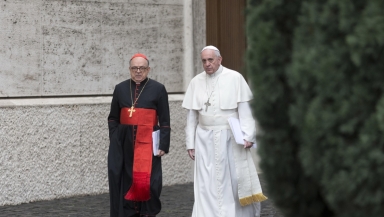
The Catholic Church cannot ignore the different crises facing the family, including divorce, violence and abuse, especially sexual abuse of children, alcohol and drug abuse, a senior prelate told nearly 200 bishops meeting in Rome.
Cardinal Raymundo Damasceno Assis, Archbishop of Aparecida in Brazil, said the Pope had accurately compared the present crisis to a "field hospital after a battle". He called on the Church to give an "adequate" response to the pressures of the present era.
There is growing pressure on the Church leadership to be more sympathetic to devout Catholics who wish to remarry after divorce, but who are denied access to Holy Communion if they do so.
Any change however is being strongly resisted by the conservative wing.
Archbishop of Glasgow Philip Tartaglia said in a homily: "When families fracture, love is the first casualty. The love which was the glue between spouses turns to hate very quickly. Intimate communion of life is replaced with a terrible logic of division. Children's peace of heart is shattered and they find themselves both loving and hating their parents at the same time."
He said forgiveness could not be "accommodation or indifference" but had to be genuine and sometimes hard-won reconciliation.
"We must have compassion for the pain and laceration of the human hearts caught up in separation, betrayal and divorce," he said, calling on the Church "to uphold God's holy purpose in marriage and in the family while also upholding those for whom that purpose has become almost impossible to attain."
He added: "In times of distress and misfortune, people still instinctively turn to the Church for hope and consolation and inspiration. We must not fail them."
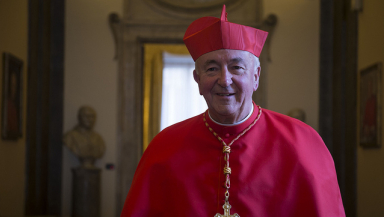
Earlier, the Archbishop of Westminster Cardinal Vincent Nichols briefed media on the Extraordinary Synod on the Family, which opened on Sunday and where sessions are now being held in private.
Using an analogy from classical music, he explained that the first serious public discussion of the themes of this synod took place last February. Discussions there had been like an "overture".
This synod was merely a "first movement". There will be a second movement, which will be the 12 months in between this and the second synod. The third movement will be an "ordinary synod" in October 2015, to be attended by elected members of bishops' conferences. The "finale" will be "whatever the Holy Father concludes", set out in an Apostolic Exhortation expressing the mind of the Church through the Pope.
He described way in which "the gift of God's mercy has come so much to the fore." This was something the Pope showed would be his emphasis from the first words he spoke. "I don't think it's been our strong suit in the last 30 years and I think what Pope Francis is calling for is a return to that lived sense of the mercy and compassion of God who always accompanies us."
One of the challenges the bishops face was "finding ways of creating a culture of mercy in the Church."
The bishops were also facing a need to deepen the Church's understanding of marriage as a sacrament. "That has been lost sight of somewhat, for all sorts of reasons." A marriage embraced in the right intention, spirit and form was an "act of God", he said.
This explained the Church's desire to embrace the "indissolubility" of marriage. Such a marriage could no more be dissolved than the eucharist returned to ordinary bread, he said.
He admitted however the bishops were being asked to look again at the reality of human frailty, and said the Pope had repeatedly emphasised that the Bishops would be starting from the wrong place if they started from an idealised version of marriage. He also said the theme of "discernment" was emerging in the Synod, and pointed out that the Pope is a Jesuit, a religious order known for its ability to exercise discernment within orthodoxy.
Cardinal Nichols admitted there was a "great deal of reflection and discernment to be done" about marriage.