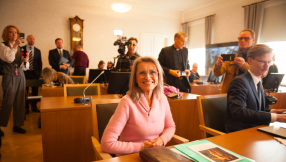
Paul Lamb suffered serious injuries in a road accident 23 years ago and now has no function in any of his limbs except a little movement in his right hand. He is challenging a High Court ruling against doctor-assisted death next month. In a statement he said: "I am in pain every single hour of every single day. I have lived with these conditions for a lot of years... I feel I cannot and do not want to keep living."
Mr Lamb is not simply asking for assisted suicide. As he himself is incapable of playing any part in ending his life, he is seeking deliberate killing by a doctor. He is also not terminally ill – which is why even Sarah Wootton, chief executive of the pro-euthanasia group Dignity In Dying, has said she cannot support him.
Nonetheless, whether we are talking about assisted suicide, or active euthanasia as in this case, there are similar general principles that help us think through these very complex and distressing issues.
First of all, deep compassion must be felt for Mr Lamb. He is enduring a situation beyond the experience of most of us. Yet, at the same time, from a Christian perspective, the action that results from compassion must be guided by right thinking, and not simply by the emotion itself. Compassion for someone does not mean inevitable agreement with what they want.
Then there is the question of autonomy: those supporting assisted suicide often ask why people should not decide when they want to die. A Christian viewpoint, however, takes into account God as the author and finisher of life – and the rightful dependence of human beings upon Him. Having said that, this argument cannot be pressed unduly, since all acknowledge there is a right place for proper medical intervention to prolong life.
Sometimes the fact of advances in healthcare is raised: people now survive accidents and illnesses which would have killed them a generation ago. This carries with it an expanding monetary burden. But while this may be true, human life cannot be valued financially. In Christian belief, every person is infinitely valuable because they are both unique and made in the image of God.
There are many dangers with assisted suicide and euthanasia: one is the possibility of vulnerable people being pressurised, however subtly, by unscrupulous relatives; another is the difficulty of establishing what valid "consent" by an individual actually is, given that serious physical conditions can lead to depression, and that even in the best of circumstances people often surprise themselves in the way they later change their minds.
Dominica Roberts of campaign group Care Not Killing says that while a few such as Mr Lamb want the law changed, "on the other side you have... perhaps hundreds of thousands of vulnerable people whom the law protects by the absolute blanket 'thou shalt not kill'." And the chief executive of disability rights group Scope, Richard Hawkes, says: "We must avoid any temptation to change assisted suicide laws based on a couple of undeniably heart-wrenching and tragic cases."
There may always be exceptions that prove the rule: but if the rule remains "thou shalt not kill" then the exceptions may perhaps be properly judged by a well-informed jury on a case by case basis. Loosen the rule, and the exceptions will simply be located further down the moral gradient. One expert who examined the Nazi euthanasia programme wrote: "It started with the attitude, basic in the euthanasia movement, that there is such a thing as a life not worthy to be lived. This attitude in its early stages concerned itself merely with severely and chronically sick. Gradually the sphere of those to be included in this category was enlarged to encompass the socially unproductive, the ideologically unwanted, the racially unwanted and finally all non-Germans."
Alex Schadenberg's new book, Exposing Vulnerable People to Euthanasia and Assisted Suicide, paints a sobering picture of euthanasia deaths without request today in parts of Europe. Australian MP Kevin Andrews has summed it up well: "The idea that there are lives unworthy to be lived is dangerous," he said. "The slippery slope is not imaginary. It exists – and despite the efforts of euthanasia sympathisers – it cannot be wished away."