You wait years for a religious movie and two come along at once. Mary Magdalene, starring Joachin Phoenix and Rooney Mara, was an intelligent and theologically literate film showing the gospel story from a woman's perspective. How does Paul, Apostle of Christ measure up?
Now available on DVD, this dramatisation of the last days of the apostle stars Jim Caviezel as Luke and James Faulkner as Paul, with Joanne Whalley as Priscilla. Paul is confined to Rome's Mamertine prison and about to suffer death in the church's first great persecution under Nero. He's old and frail, and Luke takes the risk of coming to see him so that his life story won't be lost to the church. It becomes the Acts of the Apostles.
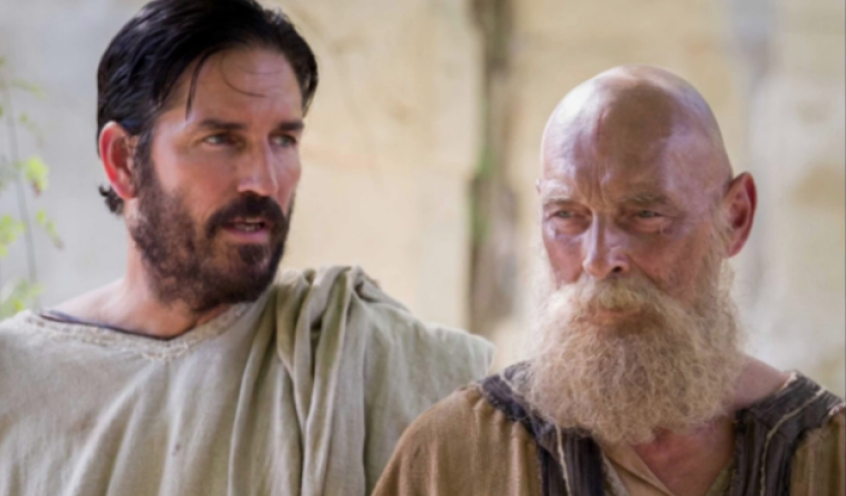
It's a worthy attempt at telling a great story, though it suffers – as many Christian dramas do – from being a bit too worthy. There's a lot of talking and not much action – but these are top quality actors, and they carry their parts very well.
Where the film scores, however, is in its depiction of life under the brutal Roman regime. It is very, very dark. Luke's first entry into Rome is lit by the flaming bodies of Christians set alight by Nero in retaliation for their supposed part in the burning of the city (it was widely assumed he'd done it himself). The scenes in the prison, in which Paul reflects on his past ('I have many regrets, made many mistakes, but everything I have done I have done for Christ') capture the claustrophic unpleasantness of the place. And the small group of terrified Christians keeps indoors as much as possible, avoiding as far as they can the attention of the authorities. If they are found, they will be put to death in the arena or casually murdered.
What should they do? Some are for resistance, violent if necessary; most are for peace, and accepting whatever God sends, a course that looks increasingly difficult in the face of the sheer brutality of Rome. Should they stay in Rome or flee – to Ephesus, the film suggests? While the details of the film as history might be questionable – naturally enough, it is a drama based on history, not history – it surely gets this right. The early church, fragile and tiny, must have had many such debates. And it's good, too, in bringing out Paul's earlier history, in which he, rather than Rome, was the scourge of the believers. We don't always appreciate the irony here.
In the end, the heroes of the film are not so much Paul and Luke, as the early church itself. Which of us, if we're honest, could say that we would remain faithful in the face of death by fire, sword or wild beasts – or, even worse, the death of those we love? But the fact that we are here, and that Christianity is a world religion, is because of the courage of those first believers.
The closing credits include the line: 'This film is dedicated to all who have been persecuted for their faith.' It's a reminder that persecution didn't end with Nero. The Beast from Revelation is alive and well today.
The DVD comes with bonus materials including a treatment of Saul's conversion and three featurettes exploring Paul's life and his friendship with Luke, and how Malta was used to recreate ancient Rome.
Paul, Apostle of Christ is a Sony Pictures/Affirm Films production.