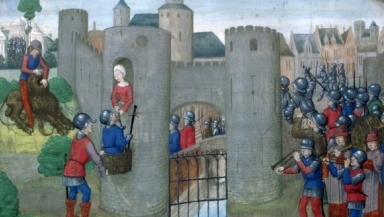
Rahab was the prostitute who hid the two Israelite spies who went to investigate the city of Jericho before the Hebrews invaded it (Joshua 2). Because she protected them, the Hebrews protected her, and she and her family were saved when the city fell (Joshua 6:25).
This is a story that looks simple but isn't. Rahab is a complicated person with divided loyalties. Her actions saved herself and her own family, but led to the destruction of her city and the deaths of many others.
What led her to behave as she did? In Hebrews 11 she is in the list of those commended for her faith (verse 31); in James 2 for her righteousness (verse 25). Most remarkable of all, in Matthew 1:5 she is named as an ancestor of Jesus himself.
But it's easy enough to look back and say she did the right thing. At the time, motivations are rarely so straightforward. And we might wonder at what led Rahab to connive at the total destruction of her city, including her friends and neighbours.
The only clue to her behaviour we have in the story itself is her profession: she's a prostitute. We don't know exactly what her status might have been in her society at that time, but traditionally such an occupation is regarded as shameful. She might have been publicly scorned by the respectable people, while visited under cover of darkness by many of those who would be embarrassed to admit it. Her loyalty to the city which treated her so badly might have been more fragile than that of other people. Convinced that the city would fall anyway, she sees a chance of rescue – and a chance to be useful, significant and honoured.
We can't know for sure what was in her mind, and we can't separate her actions from their dreadful consequences. Knowing what happened to the people of Jericho makes it hard for us to see any truly morally good outcome.
But it's in this sort of messy history that God has chosen to reveal himself. So perhaps we can say, very cautiously, that one lesson might be this:
Rahab was an outsider, driven to the margins of her society, perhaps by poverty or perhaps for some other reason. It judged her because of what she did. Instead, it was judged. The outsider received a family and a home; the oppressors were destroyed.
We can't ignore the bloodiness of the story, which comes from a different time. But at the same time we can be open to hear God's voice speaking through it. And it says lives that seem to be worthless can be redeemed and restored. There is grace for everyone and everyone has a part to play in God's purposes for the world. And it says that those who oppress the poor should beware, because judgment is coming.
Follow Mark Woods on Twitter: @RevMarkWoods