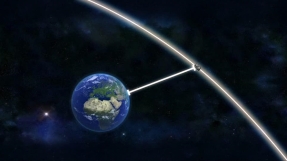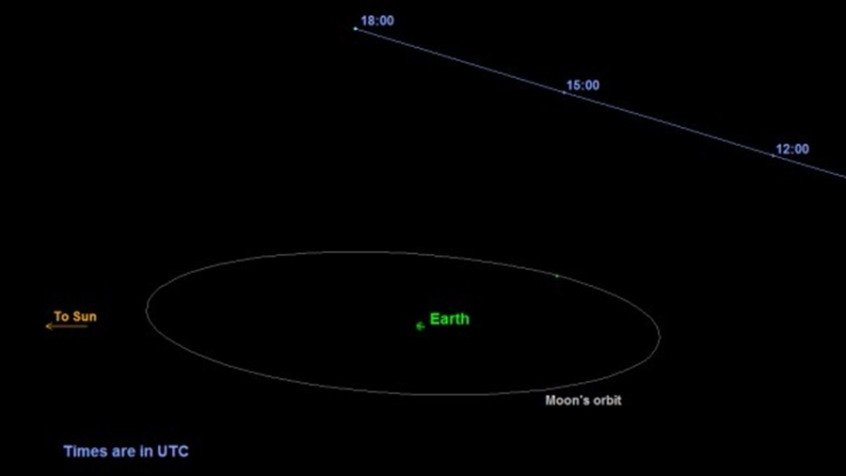
When Asteroid 2015 TB145 passes by Earth on Halloween night, space enthusiasts will be in for a visual treat, given its close proximity to Earth.
Radar astronomers, however, will be the most thrilled when the space rock makes its Earth fly-by on Oct. 31 since they will be able to test new capabilities using the asteroid.
Lance Benner, who works at the National Aeronautics and Space Administration (NASA) Jet Propulsion Laboratory (JPL) based in Pasadena, California, explained that Asteroid 2015 TB145 presents a lot of opportunities for radar astronomers.
"The close approach of 2015 TB145 at about 1.3 times the distance of the moon's orbit, coupled with its size, suggests it will be one of the best asteroids for radar imaging we'll see for several years," Benner, who leads NASA's asteroid radar research programme, said in an article posted on the JPL's website.
He added that the asteroid's safe fly-by over Earth will be an opportune time to test one of the space agency's new capabilities to get images of space objects.
"We plan to test a new capability to obtain radar images with two-meter resolution for the first time and hope to see unprecedented levels of detail," Benner said.
What exactly will the radar scientists do during Asteroid 2015 TB145's fly-by on Halloween night?
The astronomers will utilise a 34-meter (110-foot) DSS 13 antenna at Goldstone to bounce radio waves off the asteroid.
The National Radio Astronomy Observatory's Green Bank Telescope in Green Bank, West Virginia and the National Astronomy and Ionosphere Center's Arecibo Observatory in Puerto Rico will then take charge of collecting radar echoes from the approaching space rock.
Through this test, space scientists at NASA hope to get radar images of the asteroid as fine as about 7 feet (2 meters) per pixel.
This quality of radar images will reveal many details about the asteroid, including its shape, dimensions, surface features, and other physical properties.
Benner further said that Asteroid 2015 TB145 may very well be a comet, given its known physical attributes.
"The asteroid's orbit is very oblong with a high inclination to below the plane of the solar system. Such a unique orbit, along with its high encounter velocity—about 35 kilometres or 22 miles per second—raises the question of whether it may be some type of comet," Benner said.
"If so, then this would be the first time that the Goldstone radar has imaged a comet from such a close distance," he added.