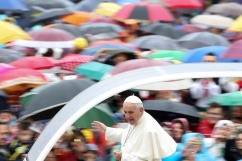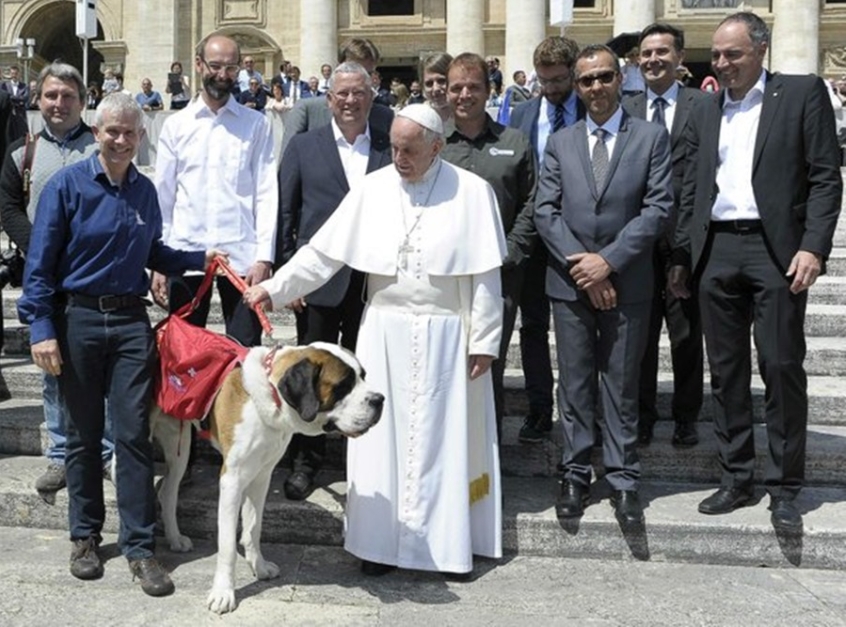
After admonishing animal lovers for treating their pets better than people during last week's general audience, Pope Francis came face to face with a special group of such animal lovers—together with their special dog named Magnum—during Wednesday's audience.
Magnum, a Saint Bernard with VIP access, even got a good pat on the head from the Pope in acknowledgment of its role in saving people's lives, according to CNA and EWTN News.
Called "Great Saint Bernard," the dog is bred by an order of priests known as Augustinian Canons. It is a descendant of Barry, one of the most famous St. Bernard rescue dogs known to history that live in one of the highest passes in the Alps connecting Switzerland and Italy.
Made famous by Beethoven in the movies, Saint Bernard dogs have gained fame for saving lives as thought them by the Augustinian monks who have been training them since the early 18th century.
The monks, who lived in the treacherous Great Saint Bernard Pass, used the dogs to help rescue stranded travelers caught in heavy snowstorms. The Great Saint Bernard Pass lies over 8,000 feet above sea level, stretching 49 miles.
Barry reportedly saved the lives of more than 40 people from around 1800-1812. In total, the St. Bernard rescue dogs are credited with saving roughly 2,000 lives.
If the dogs found an injured traveller stuck in the snow, one would typically lay on top of the person to keep him warm, while another would return to the monks' hospice to alert the monks that someone was stranded.
The Pope met Magnum and its trainers through the help of UNESCO, which not only wanted to honour the memory of the dog's famous ancestor but also get support for its effort to declare the Great Saint Bernard Pass a World Heritage Site.
Providing support to UNESCO is the Barry Foundation, which was established in 2005 to take over the breeding of the Saint Bernard dogs.
Those who accompanied Magnum to Rome to meet with the Pope included a Swiss-Italian delegation composed of politicians and representatives of various organisations linked to the dogs and the Saint Bernard Pass.