"It was that fatal and perfidious Bark," remarked Milton of a friend who drowned in a shipwreck, "Built in th' eclipse, and rigg'd with curses dark, That sunk so low that sacred head of thine."
But what's wrong with eclipses, and why should we worry about them?
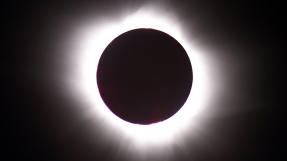
The short answer is that we shouldn't, though that didn't stop Pastor Mark Blitz warning that today's solar eclipse, in which the moon passed – or, depending on where you live, is passing – in front of the sun, providing – if you were lucky and it wasn't cloudy, a dramatic halo effect – heralded the end of the world. "When we look at where the darkness will be, it will be in northern European countries like England and Sweden where we see the rise of Islam and anti-Israel sentiment," he said.
Well, quite. Though most of us have come a little further than Rider Haggard's fictional Kukuanas in King Solomon's Mines, who were convinced that the plucky Brits had engineered an eclipse as proof of their magical powers: there is nothing supernatural about it at all.
However, eclipses are a bit spooky. No matter how well we understand them, astronomically speaking – and ancient and undeveloped cultures understood astronomy pretty well, in fact – they have attracted all sorts of myths and legends. In Vietnam it was believed that the sun was being eaten by a giant frog. Koreans held that mythical fire dogs were let loose by the lord of a dark realm to hunt the sun down. The Vikings had a similar story: sky wolves or warg were chasing and eating it. In Hindu myth, the headless demon Rahu eats the sun – but only temporarily, as since he has no body it just falls out of his throat.
The myths are told to make the strange and incomprehensible – and eclipses would have remained so for most people, no matter how much the scholars of a culture understood it – a bit more bearable, bringing an event that was outside human experience into a recognisable category. There are even Bible verses that refer to the sun becoming darkened at times of trial and judgment, though these have specific theological references.
Nowadays we are less worried – Mr Blitz excepted. Most people's concern has been limited to finding the right sort of viewing goggles on Amazon, where they sold out. And with the marvellous views brought to us by the Hubble telescope of distant galaxies and nebulae aflame with colour, eclipses are not what they were.
However, they still give us pause for thought. Suddenly we can see astronomy in action. We can observe the intricate dance of the moon and stars for ourselves. And perhaps it brings home to us again the fragility of the world, hung like a giant emerald in a waste of nothingness, perhaps the only place in the universe where life like ours is possible.
The pre-scientific creation story of Genesis 1 tells very much the same story: God makes an ordered and hospitable world out of the surrounding chaos, and seeds it with life; but it is sustained by his will and command.
Eclipses aren't awful harbingers of doom. But perhaps they should still fill us with awe at God's creation.