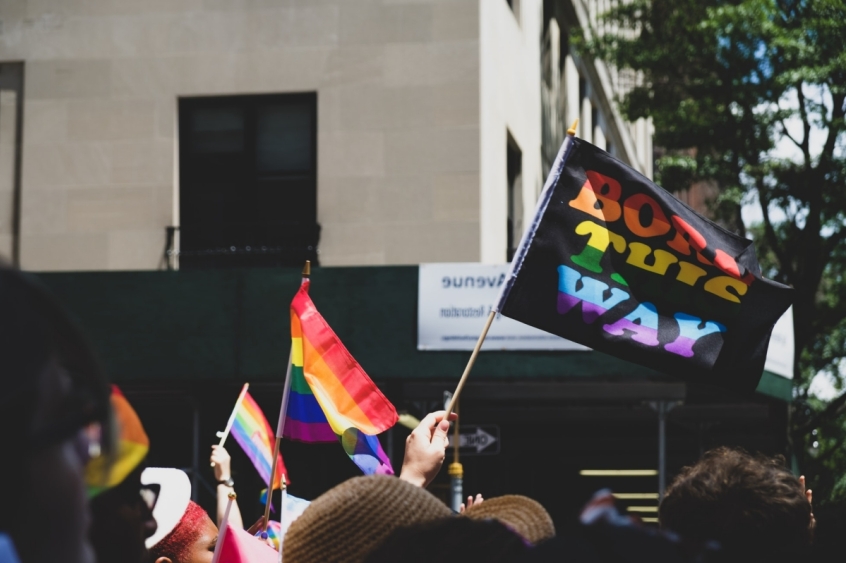
More people are identifying as LGBT than ever before in the US, according to the latest research by Gallup.
Lesbian, gay, bisexual or transgender identification grew to 5.6% in 2020, up from 4.5% in 2017 - the last time Gallup asked about this, and from 3.5% in 2012 - the year Gallup first began tracking LGBT identity.
The latest data is based on interviews with 15,000 American adults carried out during 2020.
The vast majority of Americans (86.7%) still identify as heterosexual. Another 7.6% did not answer the question about their sexual orientation.
Over half of those who identified as LGBT said they were bisexual (54.6%). while around a quarter (24.5%) were gay. Just over one in 10 (11.7%) said they were lesbian and a similar number (11.3%) identified as transgender.
Another 3.3% chose a different non-heterosexual preference like queer or same-gender-loving.
Adjustice the data to reflect the total US population, these figures equate to 3.1% of all Americans identifying as bisexual, 1.4% as gay, 0.7% as lesbian and 0.6% as transgender.
The study also found that Generation Z (born 1997-2002) are more likely than any other age group to identify as LGBT (15.9%), followed by Millennials (born 1981-1996) at 9.1%. Older generations trailed well below, with just 3.8% of Generation X (born 1965-1980), 2% of Baby Boomers (born 1946-1964) and just 1.3% of Traditionalists (born before 1946) idenfitying as LGBT.
"One of the main reasons LGBT identification has been increasing over time is that younger generations are far more likely to consider themselves to be something other than heterosexual," Gallup said.
Of the Gen Z adults who identified as LGBT, nearly three quarters (72%) said they were bisexual. This equates to around 11.5% of all Gen Z adults in the US identifying as bisexual, with about 2% identifying as gay, lesbian or transgender.
The study uncovered interesting disparities according to gender, with women more likely than men to identify as LGBT (6.4% vs 4.9%), and as bisexual (4.3% vs 1.8%).
When broken down by political ideology, liberals (13%) were far more likely than moderates (4.4%) and conservatives (2.3%) to say that they were LGBT.
This was reflected in party political affiliation as well, with 8.8% of Democrats identifying as LGBT compared to 6.5% of political independents and 1.7% of Republicans.
Gallup said: "At a time when Americans are increasingly supportive of equal rights for gay, lesbian and transgender people, a growing percentage of Americans identify themselves as LGBT. With younger generations far more likely than older generations to consider themselves LGBT, that growth should continue.
"The pronounced generational differences raise questions about whether higher LGBT identification in younger than older Americans reflects a true shift in sexual orientation, or if it merely reflects a greater willingness of younger people to identify as LGBT.
"To the extent it reflects older Americans not wanting to acknowledge an LGBT orientation, the Gallup estimates may underestimate the actual population prevalence of it."