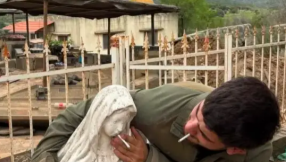
Police in Nicaragua have ended the siege of a church where opposition supporters had sought refuge after being attacked by riot police and pro-government militias, the BBC reported.
Doctors have been allowed to treat the injured inside the church in the city of Masaya, where two people have died.
Around 30 people who were inside the church were released after an intervention by the local Catholic Church.
More than 100 people have been killed in Nicaragua amid violence over the past six weeks.
The auxiliary bishop of Managua, Monsignor Silvio José Báez, praised the local priest in Masaya, Edwing Roman, and a human rights lawyer and campaigner, Álvaro Leiva, for their efforts in negotiating with the authorities.
And he urged President Daniel Ortega to end the crackdown on protests against his government.
Earlier, Monsignor Báez took to social media to warn people to stay indoors, because there were reports of snipers on the streets of Masaya.
'The priests in Masaya have told me that the San Miguel parish is surrounded by anti-riot police,' he wrote on Twitter.
'There are injured and detained people inside. No more repression in Masaya!'
Masaya, which is some 20km (12 miles) south of Managua, was one of several cities where opposition activists clashed with police yesterday.
The unrest in Nicaragua was sparked by cuts to pensions and social security.
Hours after the measure was signed into law by Ortega in April, pensioners and students took to the streets in protest.
Many people were killed in the following days. Most of the victims were university students. Human rights groups say the police acted with brutality.
Ortega revoked the legislation, but by then he himself had become the focus of the protests, according to the BBC, with the opposition and young activists are demanding his resignation.
Ortega, the former Sandinista rebel leader, is in his third consecutive term in power.
He was re-elected in 2016, after the constitution was changed in order to allow him to stand again.
Talks between the government and the opposition, which were mediated by Nicaragua's Catholic Church, broke down last week.
Several bishops taking part in the talks received death threats, which the Churchclaimed came from the government and official media.
The Inter-American Commission on Human Rights (IACHR) visited Nicaragua last month, saying that it had seen grave violations of human rights during the protests.