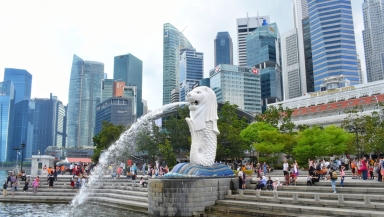
Singapore has been ranked the most religiously diverse country in the world, while the UK is one of only a handful of nations where no single religious group forms a majority, according to a major new study by the Pew Research Center.
The report, part of Pew’s ongoing Global Religious Futures project, assessed 201 countries and territories using a Religious Diversity Index (RDI) that measures how evenly seven major religious categories are represented: Christians, Muslims, Hindus, Buddhists, Jews, other religions, and the unaffiliated.
On a scale of 0 to 10, Singapore recorded 9.3, placing it nearer than any other nation to an almost equal spread of faith groups.
About 31% of its residents identify as Buddhist, while 20% say they have no religious affiliation. Christians account for 19% of the population, Muslims 16%, Hindus 5%, and a further 9% belong to other faiths.
No country achieved a perfect score of 10.
Suriname came second globally, standing out as the sole Latin American nation to feature in the top 10.
Just over half of Suriname’s population are Christian (53%), while sizeable Hindu (22%) and Muslim (13%) communities sit alongside a smaller unaffiliated group (8%).
Elsewhere, the highest-scoring nations were concentrated in the Asia-Pacific region and sub-Saharan Africa, including Taiwan, South Korea, Mauritius and Benin.
France was the sole European country to appear in the global top 10, with Christianity (46%) and people with no religious link (43%) forming its two largest groups.
By contrast, countries such as Yemen, Afghanistan and Somalia were found to be among the least religiously diverse, with Muslims accounting for 99.8% plus of their populations.
Although the UK did not feature among the most religiously diverse countries overall, it was highlighted for a different reason: it is one of just seven nations worldwide where no single religious group holds a majority. The others are South Korea, France, Australia, Singapore, Mauritius, and Ivory Coast.
The most recent UK Census data confirms that Christians now account for less than half the population in England and Wales - 46.2% say they are Christians, down from 72% in 2001.
Meanwhile, 37.2% reported having no religion, making the religiously unaffiliated the second-largest group.
The share of people describing themselves as Muslim increased from 4.9% in 2011 to 6.5% a decade later in 2021.
Separate Pew research has suggested that around 40% of people in Britain who grew up as Christians no longer consider themselves part of the faith.
Among those who went to church as children, 58% say they no longer consider themselves Christian.
The shift reflects a broader trend of religious disaffiliation across Western Europe.
However, while institutional affiliation has declined, researchers and church leaders argue that faith expression in Britain is becoming more complex rather than simply disappearing.
Some Christian traditions - including Pentecostal and Orthodox congregations - have recorded growth in recent years, often driven by younger worshippers and immigrant communities.
The US did not make the global top 10 for overall diversity, ranking 32nd. Yet when focusing on the 10 largest countries by population - all home to at least 120 million people - the US ranked as the most religiously diverse.
In 2020, Christians made up 64% of the US population, while around 30% described themselves as not being part of any faith.
Buddhists, Muslims, Jews, Hindus and “other religions” collectively made up the remaining 6%, each group comprising roughly 1-2%.
Over the past 10 years, the US became more religiously diverse as its Christian majority declined and the number of religiously unaffiliated Americans grew significantly.
In earlier findings, Pew researchers noted that for each adult who adopts a religion after growing up without one, more than three leave religion altogether with Christianity facing the largest net losses.
Globally, Christianity remains the world’s largest religious group at 2.3 billion people, but its share of the global population has fallen to 28.8%.
Over the same period, the number of religiously unaffiliated people rose to 1.9 billion - nearly a quarter of humanity - while Muslims, now numbering around 2 billion, are the fastest-growing major religious group.
Despite attention on diversity, Pew’s analysis found that most countries are still religiously homogeneous.
In 194 of the 201 countries studied, at least half the population belongs to a single religious category. In 43 places, 95% or more of residents share the same religious identity. Just 49 countries have three or more religious groups that each account for at least 5% of the population.
Regionally, the Asia-Pacific was identified as the most religiously diverse area (8.7) overall, while the Middle East and North Africa ranked as the least diverse (3.1), with populations that are overwhelmingly Muslim.
Researchers found that most of the world’s population resides in countries with a moderate level of religious diversity. Only 1% live in places classified as having a “very high” level of diversity, such as Singapore.
Worldwide, levels of religious diversity changed little between 2010 and 2020. However, roughly 24 countries experienced notable shifts, largely driven by religious disaffiliation - particularly among Christians in Europe, North America and Australasia.
In the Netherlands and New Zealand, growth in the religiously unaffiliated reshaped the balance between belief and non-belief.
In sub-Saharan Africa, meanwhile, Christianity continues to grow in absolute numbers, with the area now containing the highest proportion of the world’s Christians, overtaking Europe.
The findings paint a picture of a world in which religious identity remains powerful but increasingly fluid, especially in Western societies.
For the UK, the data confirms a historic transition: from a nation with a clear Christian majority to one characterised by plurality.