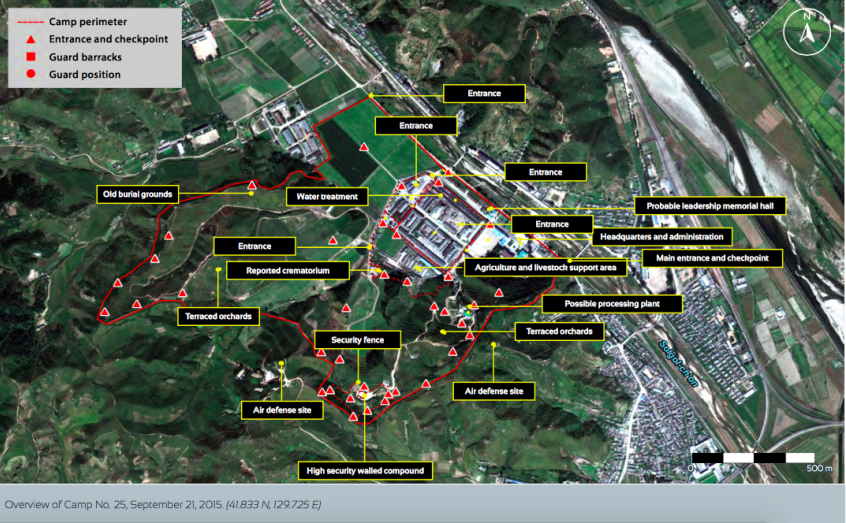
Photographs taken from space have revealed the chilling growth rate of one of North Korea's notoriously inhumane prison compounds, Camp 25.
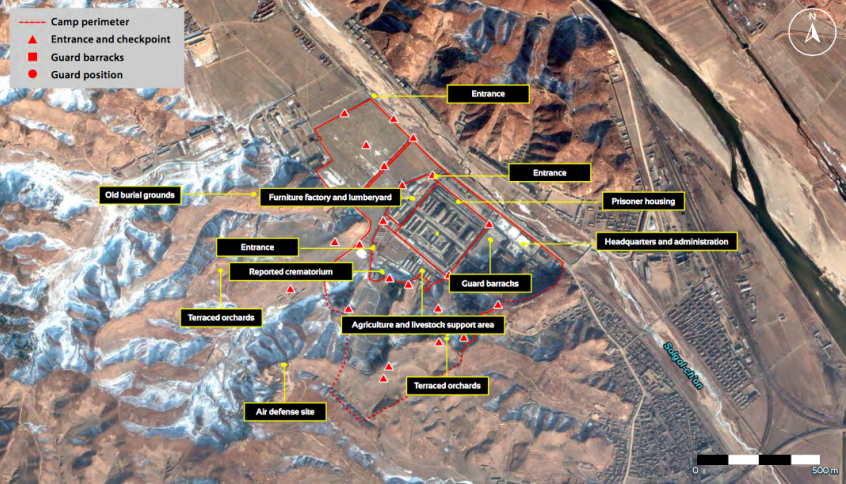
The Committee for Human Rights in North Korea reports that the camp has more than doubled in size in just five years.
Despite their size making them clearly visible from space, the regime led by dictator Kim Jong-un denies the camps even exist.
The committee, based in Washington DC, worked with AllSource Analysis, a leading provider of high-resolution earth images.
Camp 25, also known as Kwan-li-so No 25, is in Susong-dong, Chongjin-si in North Hamgyong Province on the northeast coast of North Korea.
About 5,000 political prisoners are believed to be incarcerated there.
Its biggest growth period was between 2009 and 2010, when its size increased by 72 per cent, from 565,424 square meters to 972,270 square meters, surrounded by more than 40 guard posts.
Analyst Joseph Bermudez Jr said the committee's report confirms that "primary economic activities likely carried out with prison labor are centered on agriculture and light industry."
Greg Scarlatoiu, director, said: "It continues to be difficult to quantify the precise economic importance of the slave labor provided by North Korea's political prison camps. That said, our satellite imagery analysis of Camp No 25 and other such unlawful detention facilities appears to confirm the sustained, if not increased importance of the use of forced labor under Kim Jong-un.
"Due to an intensified crackdown on attempted defections, the imprisonment of forcibly repatriated refugees, the purging of senior officials, together with associates and family members, and the possible transfer of prisoners from camps in the border areas that are now closed, Camp No 25 underwent a twofold expansion in 2009-2010. Recent satellite imagery analysis indicates that Camp No 25 continues to be fully operational at the expanded scale."
Last month, Amnesty International released its own report also proving the massive growth of the camps, often a source of nothing more than brutal slave labour for the regime.
Amnesty said: "These camps constitute the cornerstone of the country's large infrastructure dedicated to political repression and social control that enables widespread and systematic human rights abuses. Assessments of the satellite images of two political prison camps – known as kwanliso – collected in May and August show the addition of new guard posts, upgrading of a reported crematorium, and on-going agricultural activities."
Amnesty said the images were "consistent with our prior findings of forced labour and detention in North Korea's kwanliso." Amnesty has also reported rape, infanticide, torture, deliberate starvation, forced labour and executions against the up to 120,000 men, women, and children held incommunicado in political prison camps throughout the country.
Many of those detained in these camps have committed no crime, but are collectively punished through guilt by association as family members of those deemed threatening to the regime, the charity said.
Amnesty has for years campaigned about human rights abuses in North Korea and released this film documenting one woman's attempt to escape to China.
North Korea continues to be considered the worst place in the world in which to be a Christian. A damning report released by Christian Solidarity Worldwide (CSW) in September said Christians face rape, torture, enslavement and being killed for their faith. Freedom of religion or belief "is largely non-existent" under dictator Kim Jong Un's leadership, CSW said.
"Religious beliefs are seen as a threat to the loyalty demanded by the Supreme Leader, so anyone holding these beliefs is severely persecuted," the report said, noting: "Christians suffer significantly because of the anti-revolutionary and imperialist labels attached to them by the country's leadership."
Among the documented incidents against Christians are "being hung on a cross over a fire, crushed under a steamroller, herded off bridges and trampled underfoot".