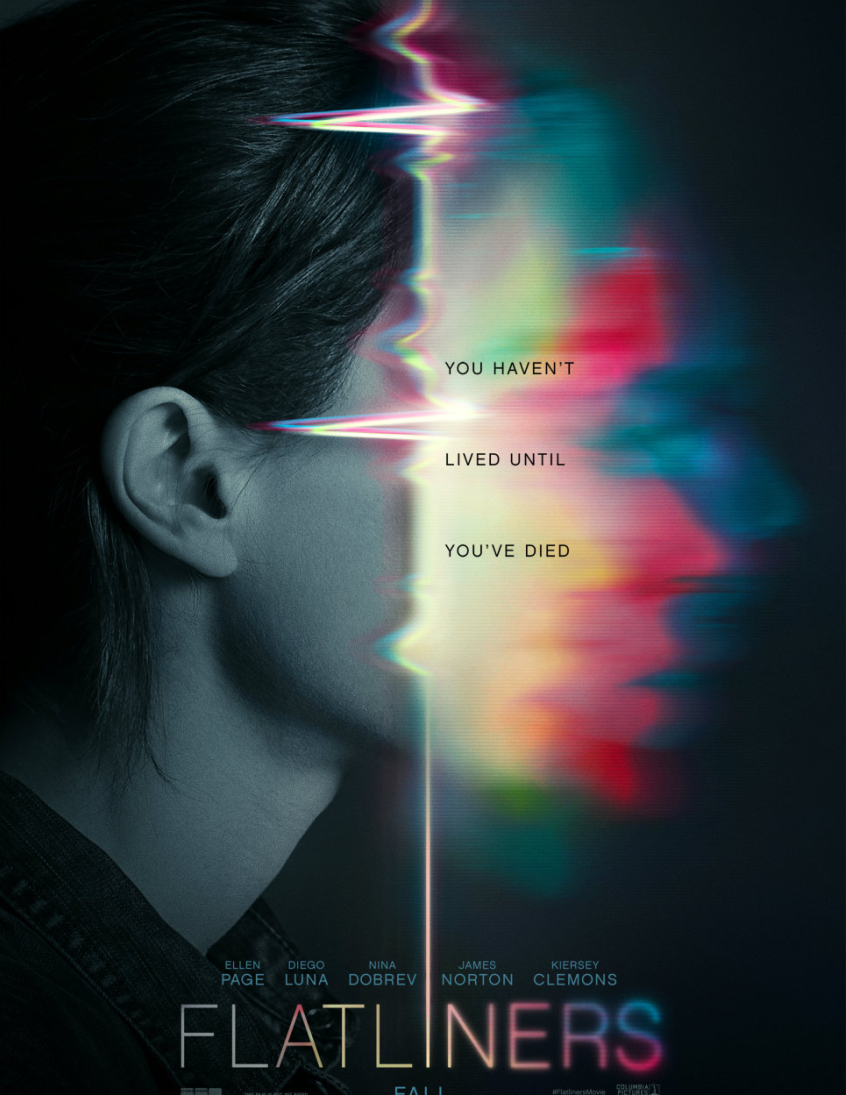
It's been 27 years since the first Flatliners movie – a classic '90s shocker about five medical students who discover a way to tap into the afterlife through brief bursts of death. Now Sony is resurrecting the franchise with a sequel – confusingly also called Flatliners – which explores the same idea, and from the newly-released trailer, it seems like the film will offer plenty of theological food for thought.
The timing of the film's reemergence is fascinating. The first instalment arrived at a time when the Cold War was coming to an end, but the threat of apocalypse still hung over the world. It was part of a slew of '80s and early-'90s teen films which explored dark themes of death and its consequences; contemporaries included the first two Terminator films, the Nightmare on Elm Street series, The Lost Boys and WarGames (also now being re-made). These movies, all aimed at older teenager viewers, tapped in to a cultural sense that life as we know it might come to an end at any moment. In that context, 2017 seems a fitting moment for another slice of Flatliners, as the world – and particularly the younger generations – find themselves gazing at an uncertain future, and perhaps asking those Big Questions once again.
The second instalment sees a new cast (plus Kiefer Sutherland, reprising his role from the first film) undertaking a set of experiments which involve stopping the human heart and momentarily 'killing' themselves in order to experience several minutes of an apparent afterlife. As they each see the wonders contained on 'the other side', they begin to extend the experiment for a longer and longer period, cheating death to gain a sneak glimpse of life after death. Inevitably the experiment turns sour, just as it did in the original.
While it certainly doesn't seem to project a Christian perspective on what happens when we die, the film will raise some interesting questions. For a start, it's unusual in that it takes place in a cinematic universe where a spiritual dimension very definitely exists. In a world where atheists plaster signs on buses telling you that it doesn't, it's a fairly strong counter-message, and one that is helpful to the Christian evangelist narrative at such a time of uncertainty.
The trailer also includes some interesting nods toward faith, including shots of a stained-glass-windowed church, high-pitched Gregorian-style chanting and the prominence of the great apologetics question, 'What happens to us after we die?' It also appears that the characters become perfected, and even attain the ability to heal others, through the process of crossing over into death.
Despite residing with at least one foot in the horror genre, Flatliners looks set to be one of 2017's most theologically-minded films. And given that the tagline for the movie is, 'You haven't lived until you've died,' it's a safe bet that many youth evangelists will be using it as a cultural bridge to talk about the Christian story later this year.
The official trailer, which includes brief, upsetting scenes, can be viewed here.
Martin Saunders is a Contributing Editor for Christian Today and the Deputy CEO of Youthscape. Follow him on Twitter @martinsaunders.