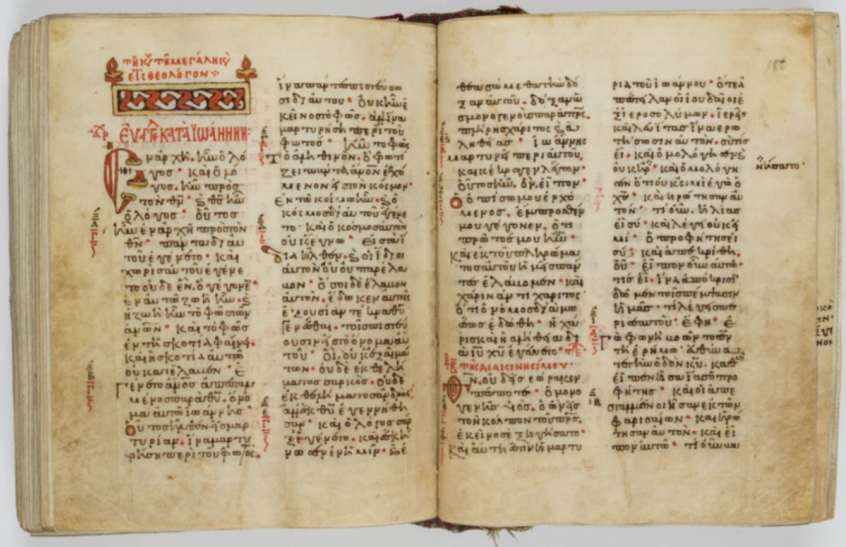
(CP) Leaders from the Museum of the Bible in Washington, D.C., traveled to Greece this week to formally return a 10th-century, handwritten Gospel manuscript looted by Bulgarian troops in 1917.
The manuscript, known as "Evangelistary Manuscript 220," is one of the world's oldest hand-lettered Gospels and was among hundreds of priceless objects looted from the Theotokos Eikosiphoinissa (Kosinitza) Monastery in Greece during World War I.
Without knowing this, the Museum of the Bible purchased the manuscript at a Christie's auction in 2011.
A formal return ceremony was held Thursday at the historic monastery in Drama, officiated by Archbishop Elpidophoros of America. The ceremony was attended by Agathangelos Siskos, archivist of the Ecumenical Patriarchate; and Museum of the Bible Founder Steve Green, who is also the president of the craft store chain Hobby Lobby.
After the doxology service, Green was awarded the "Grand Cross" — the highest honor of the Metropolis of Drama — by Metropolitan Panteleimon of Xanthi.
Green was joined in traveling to the event by the museum's Chief Curatorial Officer Jeffrey Kloha, Associate Curator of Medieval Manuscripts Brian Hyland and Museum of the Bible board member Elizabeth Prodromou.
"We are honored to partner with the Ecumenical Patriarch on a permanent exhibition of biblical manuscripts and religious objects connected to the Bible," Green said in a statement sent to The Christian Post.
In a statement, Ecumenical Patriarch Bartholomew I, the world leader of the Eastern Orthodox Church, thanked the museum for returning the manuscript.
"It is a true blessing for the monastic sisterhood and the Christian world to see the religious artefacts that were removed from the Monastery officially return to their natural home and used hereafter for the spiritual edification of the faithful, and by art and history scholars," the patriarch said in a statement.
The manuscript had been used for hundreds of years in religious services before it was stolen.
Kloha said the manuscript is important as part of the history of the New Testament in Greek, "but it also tells of at least two communities that used it for prayer and devotion century after century and of the day of violence and sacrilege over a century ago."
"Now, this manuscript can tell a new story," the curator added, "a story of reunion and hope that the pages of this manuscript will continue to give light, even though many have tried to extinguish that light."
In 2020, the museum informed Patriarch Bartholomew about the intended return of the manuscript, which entered the museum's collection in 2014.
The patriarch allowed the museum to display the manuscript in October 2021, in time for the patriarch's apostolic visit last year.
The patriarch also loaned three more manuscripts "as part of the collaboration in a permanent exhibit at the museum as a gesture of gratitude for the Gospel manuscript's return."
The museum has investigated its collections in recent years and "hopes that other collections in the U.S. that also possess manuscripts from the monastery will likewise voluntarily return them to their rightful home."
In January 2021, the Museum of the Bible transferred control of 5,000 disputed manuscripts and bits of papyrus to the U.S. government, which then repatriated the artefacts to Egypt, where the items were thought to have been illegally shipped during the Arab Spring.
The artefacts included manuscript fragments, funeral masks, parts of coffins and the heads of statues.