Christians in the US are absorbing non-biblical worldviews, according to research from the Barna organisation.
In a study conducted with Summit Ministries, Barna found 'strong agreement with ideas unique to nonbiblical worldviews among practising Christians'. Only 17 per cent, it said, had a 'biblical worldview'.
It said nearly four in 10 (38 per cent) of practising Christians were sympathetic to some Muslim teachings, while 61 per cent agreed with ideas rooted in New Spirituality, 54 per cent resonated with postmodernist views, 36 per cent accepted ideas associated with Marxism and 29 per cent believed ideas based on secularism.
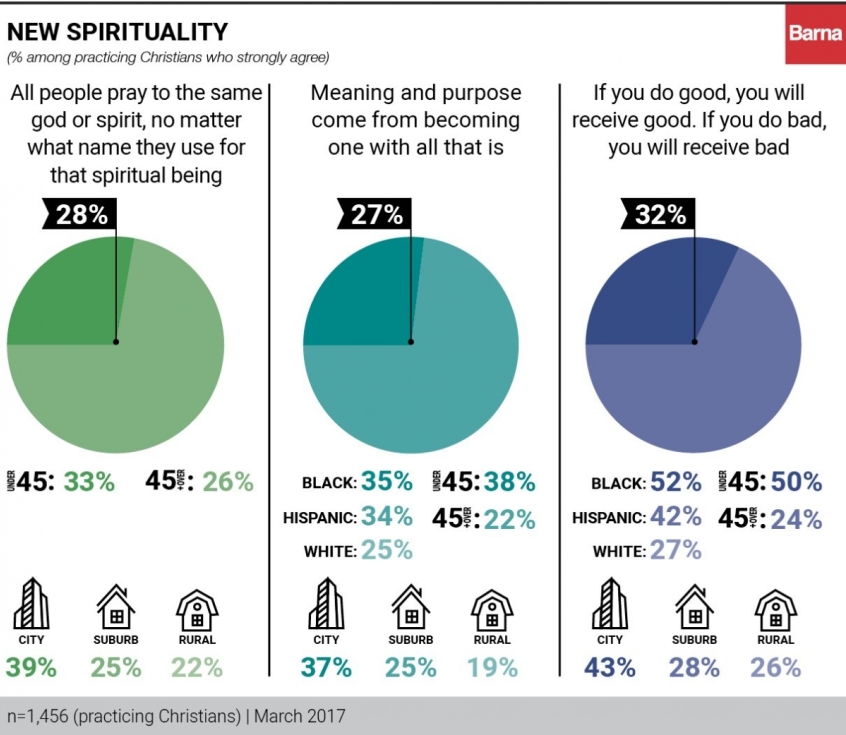
The trend was particularly notable for younger people, who could be more than eight times as likely to accept these views than their elders. Men are more open to them than women and city-dwellers than rural residents.
For instance, around three in 10 practising Christians strongly agree that 'all people pray to the same god or spirit, no matter what name they use for that spiritual being'. A third also strongly agree that 'if you do good, you will receive good, and if you do bad, you will receive bad', an idea based on Eastern ideas of karma.
A fifth of practising Christians believe that 'meaning and purpose comes from working hard to earn as much as possible so you can make the most of life', a secularist position. A quarter (23 per cent) strongly agree that 'what is right or wrong depends on what a person believes' – a view associated with post-modernism.
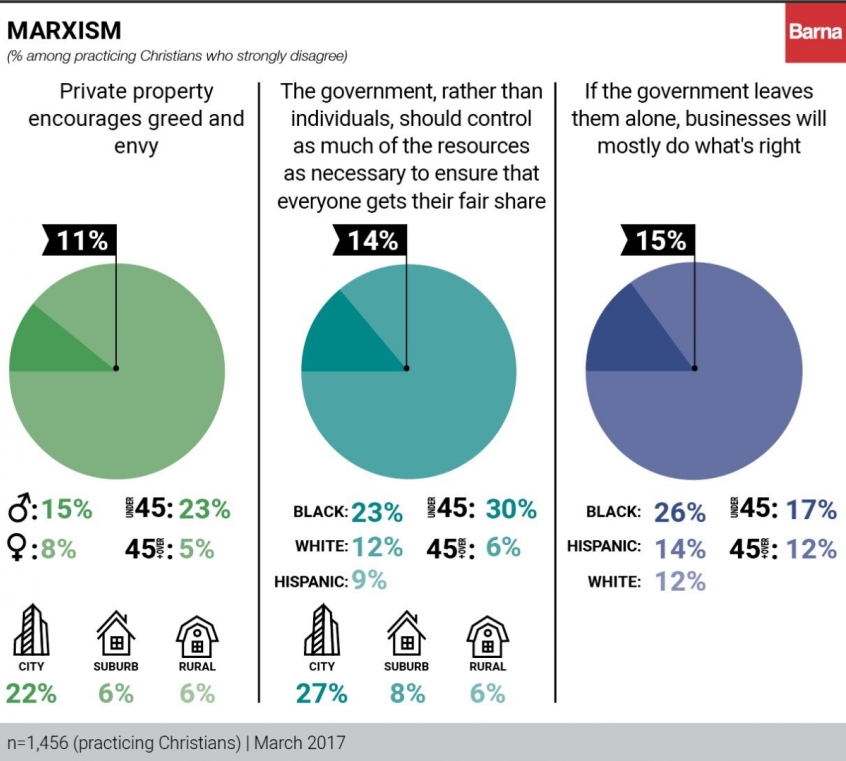
The Barna study classed as 'Marxist' and anti-Christian any agreement with the statement that 'private property encourages greed and envy' (expressed by 11 per cent of practising Christians), that 'the government, rather than individuals, should control as much of the resources as necessary to ensure everyone gets their fair share' (14 per cent) and 'if the government leaves them alone, businesses will mostly do what's right (15 per cent).
Senior vice president of research Brooke Hempell said: 'We have observed and reported on increasing pluralism, relativism and moral decline among Americans and even in the Church. Nevertheless, it is striking how pervasive some of these beliefs are among people who are actively engaged in the Christian faith.'
Hempell said: 'The challenge with competing worldviews is that there are fragments of similarities to some Christian teachings, and some may recognise and latch on to these ideas, not realising they are distortions of biblical truths. The call for the Church, and its teachers and thinkers, is to help Christians dissect popular beliefs before allowing them to settle in their own ideology.'