One year into the Trump presidency, a new poll has surveyed US adults on their perspective on the controversial administration. Most Americans do not trust the president 'at all', but while Trump has frequently divided US Christians, most from all denominations still pray for him.
The study by Barna, released this week, recaps some of the major moments from the Trump presidency's first year, including the controversy over his inauguration crowd size, the spectre of 'fake news' and allegations of sexual assault.
There have been several spats within the American church regarding Trump in the past 18 months; he won 80 per cent of the votes of white evangelicals in the 2016 election, but attracted derision, disapproval and protests from many other believers. As Barna notes, significant attention surrounded an image of evangelical leaders laying their hands on Trump in prayer, prompting Barna's question: 'How many citizens are privately praying for the president?'
A minority of Americans (37 per cent) say they pray for Trump, and among those in non-Christian religions, just 18 per cent do. Barna adds: 'Despite their high levels of disapproval and low levels of trust in Trump, black Americans are almost as likely as white Americans to pray for him (41 per cent and 44 per cent, respectively).'
However, among 'practising' Christian groups, intercessory support is far more widespread (69 per cent). Perhaps unsurprisingly, evangelicals are the most supportive: 88 per cent pray for the president, as do 76 per cent of non-mainline practising Christians, 65 per cent of practising Catholics and 59 per cent of mainline practising Christians.
Some partisan leanings remain: 82 per cent of Republican practising Christians pray for Trump, compared with 53 per cent of Democrat practising Christians. In general Republicans are twice as likely to pray for Trump than Democrats (60 per cent against 27 per cent).
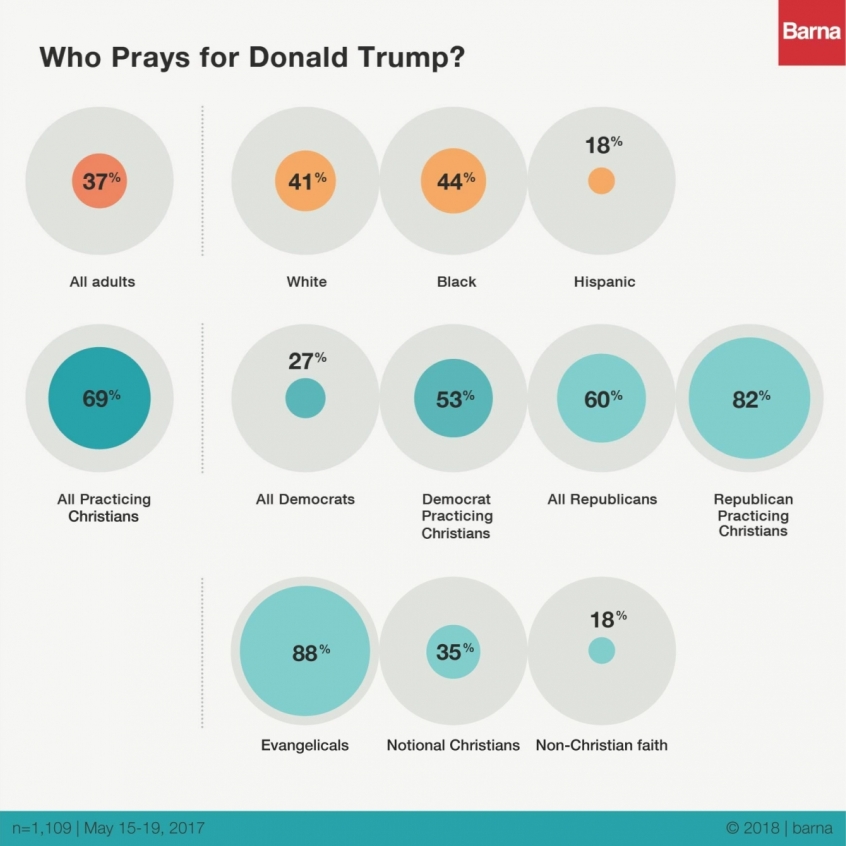
Amongst those described as 'notional' Christians, just 35 per cent pray for the president, less than the national average.
Barna's study included several other findings. According to a mid-2017 poll, most Americans (56 per cent) do not trust Trump 'at all', and among Trump voters only 51 per cent 'definitely' trust him. Almost half (49 per cent) of Americans did not support Trump's travel ban – the executive order blocking the immigration of individuals from several majority-Muslim countries; 36 per cent did support it.
Many Americans (31 per cent) also believe that 'fake news' has more to do with misrepresentation and exaggeration on social media than deliberate deception on the part of media organisations, who are frequently a target of Trump's. However, evangelicals were the most opinionated on the issue, with 51 per cent saying, like 46 per cent of Republicans, that 'mainstream liberal media' is to blame for 'fake news'.