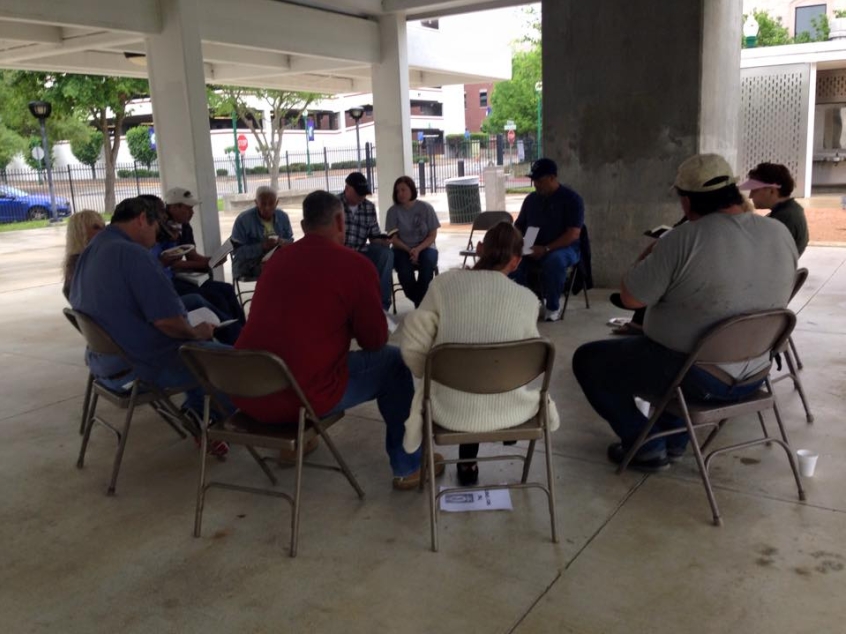
Jerry Vineyard is a pastor leading a church for the homeless and addicted in a park in Conroe, Texas. His journey to building a church without a building is one of listening to God and going against the grain. The church – the Under Over Fellowship – just celebrated its fifth anniversary and has a membership of around 75, half of them either homeless or in transition.
Under Over, a name inspired by Romans 6.14: that since we are "under his grace", Christ is "over our sin", now has two transitional houses with programmes helping men and women with their rehabilitation. Jerry and other members of the fellowship disciple the men and women spiritually and equip them practically over the course of six months.
"It started when I was a high school teacher and a football coach. I started working with some of the kids in my church and felt called to be a youth pastor," he told Christian Today.
"The high school was in a low income part of our county – the kids were poor and didn't grow up in church and so we started a bus ministry, which would bring in 90-120 kids every Wednesday evening, Sunday morning and night."
God was moving, but Jerry noticed that "the church began a separation between the bus kids and the church kids. The church liked the numbers the bus ministry brought, but not the baggage that came with the kids.
"I felt angry, because I felt like I was reading a different Bible to them," he said. So he moved on.
This narrative repeated itself; Jerry found that churches didn't like their order to be disrupted, even by the work God was doing.
So he started working on a street ministry, going to different places each weekend – parks, low-income housing and nursing homes – but he soon realised that being constantly on the move meant it was impossible to disciple people.
"We would see the single mum of five kids in the low income housing and she would be saved, but then it would be impossible for her to meet up with us again, as she didn't have a car to get to the places we were going," he said.
It became clear he needed to be in one place. So he and his wife sold their house, moved a hundred miles north, and Jerry became pastor of a church there.
For six months things went well, but he began to realise that the congregation "loved the building more than they loved reaching the lost with the gospel. I began to feel angry again.
"I was asking God what to do. I went into the sanctuary of the church building on a Friday afternoon and began to sing and pray. When I was crying out to God, the only homeless person in the city came and burst into the sanctuary and called out to me: 'Can you help me?'
"That's the moment I knew I had to move back to my home town and start a church outside for anyone who wanted to come."
Five years later, and the church has grown. They still meet in Heritage Place Park in Conroe every Sunday to eat, pray and worship together, but they do own a couple of buildings to enable the ministries that have developed.
In so many churches, "so much money is invested in a building that is only used three or four hours a week, but we said if we're going to buy a building we are going to use it 24 hours, seven days a week," Jerry said.
And that's what they do. The building is home to men who are taking part in the discipleship programme, called The Way, and also houses the machinery needed for their carpentry ministry, a food bank, laundry and showers.
"So many small churches are struggling, and part of that is because they have outsourced their ministries to parachurch ministries," Jerry added. Churches do outsource to some really good organisations, "but Jesus never placed that calling to serve the needy on parachurch ministries or organisations, but on the body of Christ."
This is the key, Jerry said, to the call of the Church.
One of the struggles for churches which are fearful of serving the poor and needy is that they are "afraid of being taken advantage of. But, you know what, people took advantage of Jesus every single day. If we can get past this fear and realise that if people are taking advantage of the church we must look something like Jesus, everything would change," he said.
"It sucks some times," he added, candidly. "When we read the Bible and in Paul, where it says the wages of sin is death, that is the truth. You are going to get your hands dirty and you are going to get involved in people's lives. It is dirty and painful, but it is worth it."