Today is the church feast day of William Tyndale, the scholar, rebel and martyr who was executed on this day in 1536. Tyndale's legacy endures to this day – was he England's Martin Luther?
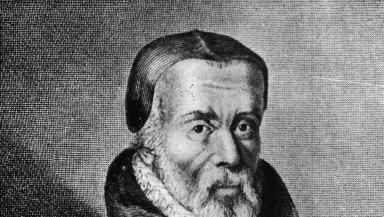
It's 500 years since Luther's Reformation began with that friar's challenge to the majesty of the Catholic Church – and went on to transform the world. Tyndale might not have the theological or rhetorical legacy of Luther, but he carried the torch of the Protestant Reformation in England, and suffered greatly for it. Most crucially, his ground-breaking work on translating the Bible into English was decisive for the Bible as we know it today.
Born around 1494 in Gloucestershire, he was an Oxford and Cambridge-educated student, ordained as a priest in around 1521. But Tyndale sympathised with the Reformers' cause, and soon began his own work translating Scripture into English from its original languages for the first time (John Wycliffe's 14<sup>th century translation was based on the Latin Vulgate, not Hebrew and Greek) taking on the Protestant vision to get 'back to the Bible', and make it accessible to all.
But he received little support in England and moved to Germany to continue his work. When he completed his translation of the Greek New Testament, he had copies smuggled to England, where it found immense popularity.
This infuriated English Church authorities, who burned any copy of Tyndale's work they could find – which, as historian J Stephen Lang has noted, provided the spectacular irony of clerics burning Bibles.
Tyndale endeavoured to translate the entirety of Scripture, and set out on the Hebrew Old Testament, going from Genesis and getting as far as 2 Chronicles. But he was beset by betrayal: his supposed friend Henry Phillips turned him in, and Tyndale was imprisoned for his Protestant crimes. Even in jail he tried to complete his Hebrew translation. After 500 days of incarceration, he was strangled and burned at the stake October 6, 1536. His final words were full of evangelical fervour: 'Lord, open the King of England's eyes!'
Today it's hard to imagine the world without an English Bible, and there could now be as many as 900 of such translations in existence – but before Tyndale it had never happened. He's known as the Father of the English Bible, since the later, epochal work of the King James Version of the Bible largely consisted of Tyndale's scholarly and accessible translations.
For example, now iconic lines of Scripture such as 'Am I my brother's keeper?', 'Blessed are the peacemakers', 'the salt of the earth,' 'the powers that be,' 'the spirit is willing, but the flesh is weak,' and 'with God all things are possible,' were drawn straight from Tyndale's work for the KJV.
And Paul's famous homily on 'love' in 1 Corinthians 13 was rendered as 'charity' in the KJV, but it was Tyndale who translated the Greek agape as 'love', and it's his popular rendering that has endured.
The English language, as with scholarly understanding, continues to evolve – and so the work of Bible translation continues today.
But without the courage and genius of men like Tyndale, who challenged the status quo before them and died for doing so, it might never have been possible.