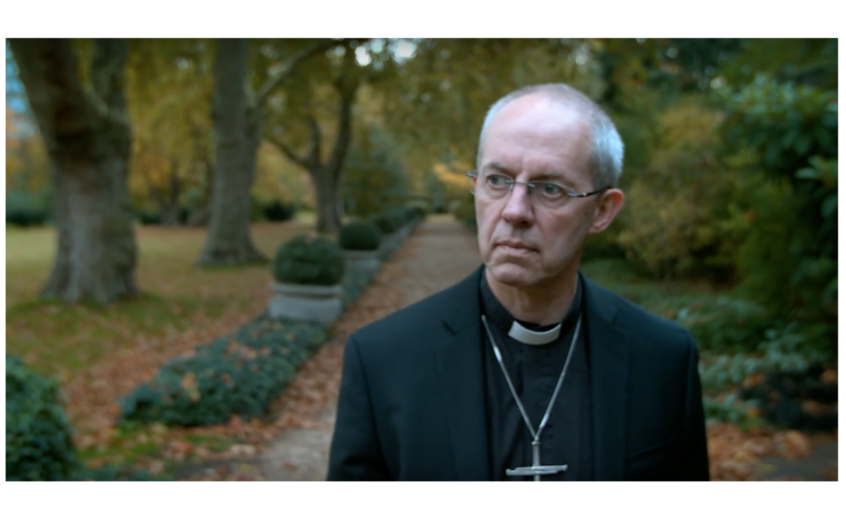
The Archbishop of Canterbur, Justin Welby, made an impassioned plea for Christian unity at the weekend, saying he hopes the Church can show the world it's possible to 'love, even when you disagree passionately'.
Welby was speaking at the Christian festival Spring Harvest 2017, which this year is titled 'One for All', emphasising a message of unity.
On Sunday morning the Archbishop gave a sometimes light-hearted address in which he explained 'the advantages of forgetting about unity'. Forgetting about the project of unity, Welby said, included the benefits of fewer meetings, more energy, more pleasure, simplicity and comforting familiarity.
On the other hand, he wryly noted, there were 'some minor problems' with the idea. 'If we're not united, we won't love like God loves, be united like God is united, or share like God does in the Trinity.'
Subsequently, Welby said, 'we won't know Jesus or the love of the Father like we could', and 'we won't win people to Christ as we could'.
'So those are some downsides', the Archbishop noted.
He was later joined in a panel discussion by Catholic author Charles Whitehead, a leading figure in the Catholic Charismatic renewal movement, and Malcolm Duncan, a Baptist minister and former chair of Spring Harvest.
Reflecting on historic divides between Catholics and Protestants, Whitehead said he was hopeful about the future.
'I think the Holy Spirit is really drawing us together. This is not a human initiative, it's not a good idea we had last Wednesday morning,' he said.
He said there had been 'a lot of historical misunderstanding, prejudice of different kinds', between the two groups. While he acknowledged some 'huge differences' in beliefs, that he said shouldn't be ignored, he also said he had seen 'a real desire to build relationship. When that's present, the sky is the limit'.
Welby reflected on the legacy of the Protestant Reformation, the 500<sup>th anniversary of which is celebrated this year. He said: 'The Reformation was a wonderful moment of blessing, people finding Scripture in their own language, re-finding the understanding of justification, forgiveness through faith in Jesus Christ, without works...but it resulted in a profound disunity in the Church which we live with to this day.
'That disunity is very, very damaging to the witness of the Church and it led in the 16<sup>th and 17<sup>th centuries to the most appalling cruelty, of which the Church needs to acknowledge its failure to love even when we disagree.'
Malcom Duncan spoke about his lessons from growing up amidst brutal, violent Catholic and Protestant division in the Troubles in Northern Ireland. His first lesson from that period was that 'you've got to talk with those you disagree with if you want to progress peace'.
He quoted former President Bill Clinton, who at the funeral of the divisive, controversial figure Martin McGuiness, had said that 'we have to allow our definition of "us" to get bigger, and our definition of "them" to get smaller'. Duncan made a call for active 'peace-making' – not simply passive 'peace-keeping' – echoing the conciliatory plea for unity he made earlier in the week.
Welby reflected on his meeting with Pope Francis, and how the pair had spoken privately not about Church politics, but about prayer.
Welby had asked the Pope, 'What is prayer?'
'He said: "When we pray, God makes room in our lives and in the world for mercy and grace." God makes room.'
Lastly Welby was asked directly about the challenges of Church unity amid impassioned debates about human sexuality.
Welby said that in western society in general 'we've become less and less good at dealing with people with whom we disagree'. He hopes the Church can embody an alternative: 'My prayer on this subject is that we demonstrate to the world that you can love even when you disagree passionately. And we can love one another even when we think one another is very, very wrong on a very serious matter.
'It's when we do that that I think we've got something that demonstrates that God has broken into the world, conquered evil, risen from the dead, ascended to heaven, sent the Holy Spirit...and that changes everything, not just the bits we want changed.
'It's that business of learning to disagree in a way that says to the world "God is in charge" that really we need to do.'
Some critics argue that putting too much emphasis on 'good disagreement' on key issues prioritises 'unity' over 'truth'. Countering this, Welby said: 'I defy anyone to show anywhere in the Bible where there is a conflict between unity and truth. It doesn't exist.'
Welby says he prays for a Church that is 'passionate about truth...but at the heart of that truth, Jesus tells us we are to love one another, love our neighbour, and love our enemies. I just don't see many people left out of that'.
You can follow @JosephHartropp on Twitter