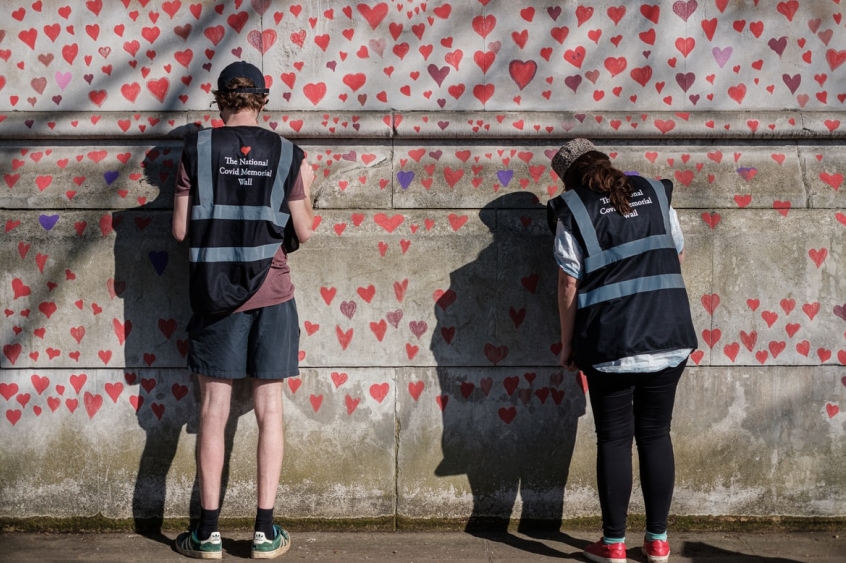
It's been just over three years since our lives were forced indoors and online with the arrival of the deadly Covid-19 virus. For a time, life bore very different dimensions: the wearing of masks; the need to keep our distance. Even greeting someone or coughing in public became impolite because of the risk of infection.
At its lowest points of lockdown, it became hard to imagine how normal life could ever resume. And yet here we are. Looking back, the pandemic now seems quite surreal.
How do we make sense of it all?
Why did a pathogenic virus bring the world to a halt and take the lives of far too many loved ones? And why would God allow this? There are no easy answers here. Especially when we learn that there are billions of viruses on earth and 99% of them are in fact vital for life.
If we were to wipe out all viruses, life on earth would survive for only a couple more days. So why the harmful 1%? There are many layers of response here. If God doesn't exist, what kind of explanation can be relied upon?
Some might argue that this is just the way the world is, and the occasionally rogue virus is the flip side of a world full of life-sustaining viruses. Once-in-a-while a harmful strain arises.
But there's nothing right or wrong about this. It's just the luck of the draw.
Intellectually this may solve the problem to some extent, but it doesn't help us make sense of the rawness, grief and anger that many are left with as they process the last three years. Many would agree that there was nothing neutral about the events of 2020 and 2021. Life was out of kilter. There was much that was wrong.
The Christian faith uniquely helps us to make sense of this. Disasters and diseases happen because we live on a broken planet. People, nature and biology are extraordinary and beautiful, but also fundamentally flawed. Perhaps paradoxically, the objection that there is much that is not right with the world is entirely at home within a Christian framework. God who is perfectly good has made a good world, but that good world has also somehow gone wrong.
How exactly things have gone wrong is the subject of much discussion but at its core is the belief that there are spiritual reasons, as well as natural ones, for the brokenness we see in nature and biology - brokenness that stems from rebellion against God.
But what does the Christian faith have to say to people as they process the pandemic? It says that God has not left us alone in our suffering. Into our broken planet stepped God himself in Jesus Christ to meet people in their pain. He didn't merely send instructions on how to cope with disease and sickness but came down himself to do something about it – both through direct healing and by laying the foundations for modern healthcare in his radically countercultural command to love your neighbour as yourself.
Jesus went on to suffer like us and for us through his brutal crucifixion at the hands of Roman executioners. A death that left him struggling to breathe for several hours, physically broken and God forsaken. Jesus did this so that we could be restored to God. He died and rose so that we could live, even if the forces of nature throw their worst at us, and have life here and now, and a life that continues beyond the grave. It is a reality in which God will make all things new.
What does the Christian faith have to say in the aftermath of covid? Because of Jesus, whatever life throws at you, you need never go through it alone. Suffering doesn't have to have the last word and death is not the end. The question is: will we trust him?
Dr Sharon Dirckx is a speaker and author. Her latest book, Broken Planet, was published with IVP in February 2023.